
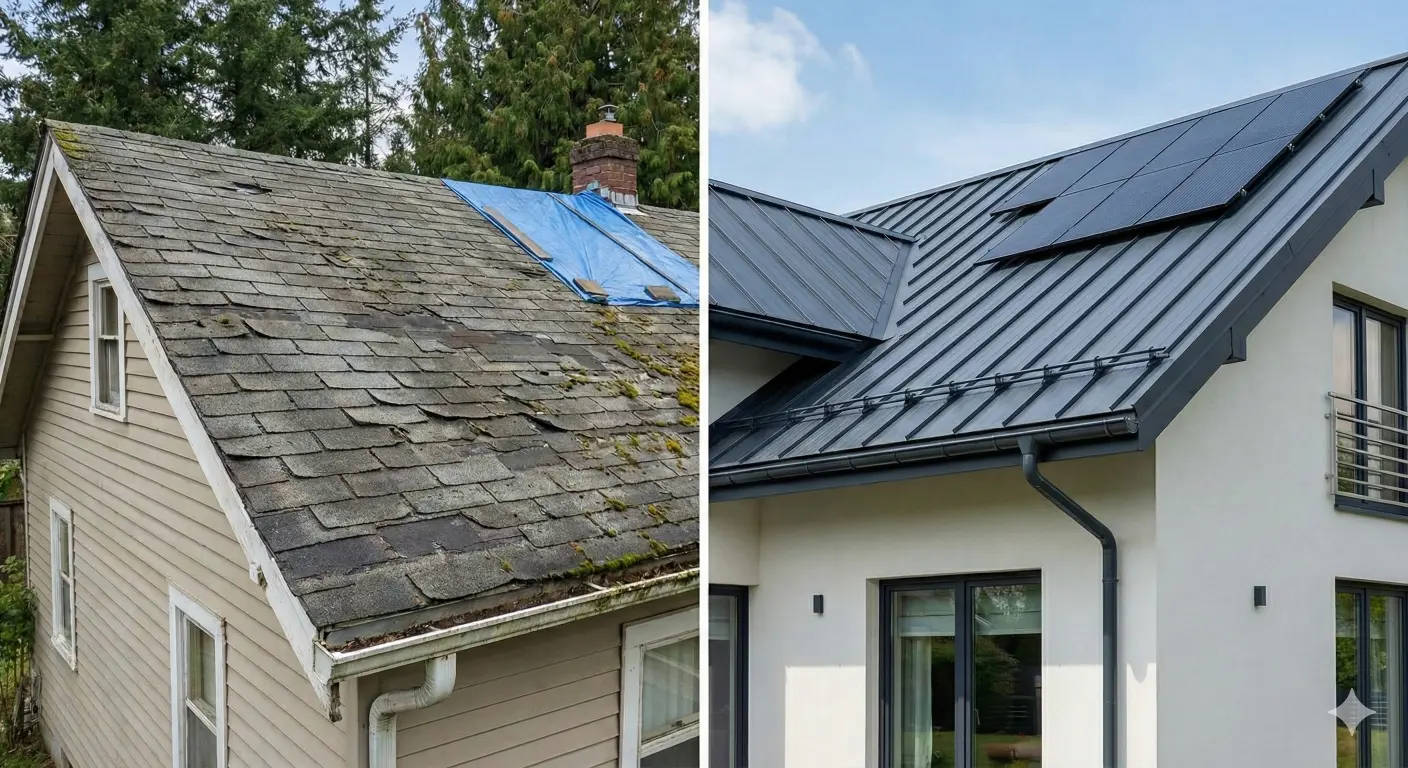
When you’re staring at three or four roof bids, it’s tempting to slide straight to the right-hand column and circle the lowest number. On paper, the cheapest option feels responsible—especially when budgets are tight.
But roofs don’t live on paper. They live through hail seasons, summer heat, surprise leaks, and evolving insurance rules. The cheap roof lifetime cost often ends up much higher once you factor in repairs, interior damage, rising labor and material prices, and possibly paying for a second replacement sooner than you expected.
Nationally, a new asphalt shingle roof often runs $7,000–$10,000+ for an average-size home, with Georgia-specific averages around $6,900–$21,000, depending on size and material. That’s a serious investment—so it makes sense to think in terms of cost of ownership, not just day-one price.
This article walks through lifespan data and simple “Scenario A vs B vs C” math so you can see how a budget 3-tab roof compares to mid-range architectural and premium impact-resistant systems over 20+ years. The goal isn’t to shame anyone who’s bought cheap before, but to help you make a clearer decision now.
Why the Lowest Bid Is Rarely the Lowest Cost
The illusion of savings when you only look at year one
A low bid usually comes from some combination of:
- Lower-cost materials (often basic 3-tab shingles)
- Lower labor numbers (smaller crew, less time on site)
- Minimal allowance for decking, ventilation, or code upgrades
- Little room for callbacks or warranty service
On day one, that looks like savings. But industry cost guides show that asphalt shingle labor and materials now make up a large portion of total roof cost, and both have climbed sharply in the last few years. When you need repairs or an early replacement, you’re not paying 2025 prices—you’re paying whatever the market looks like in 2030 or 2035.
How leaks, repairs, and early failure compound over time
Think of a cheap roof as a low-priced car with high maintenance cost:
- More leak risk as the roof ages faster
- More repair visits, each with a service call fee plus materials
- Higher chance of interior damage (drywall, paint, flooring, insulation)
- More disruption—time off work, noise, tarps, and stress
Roof calculators and contractor data suggest that even a “simple” asphalt roof replacement is already in the mid four to low five figures for many homes. Multiply that by leaks, deductibles, and earlier repeat work, and the “bargain” stops looking cheap.
Rising labor and material costs: why “future you” pays more
Roofing companies, manufacturers, and independent roofing blogs all echo the same theme: roofing costs have risen significantly since 2020 and are still under pressure from inflation, supply chains, and labor shortages.
That means if a cheap roof fails early, your second roof will almost certainly cost more per square foot than the first. “Future you” is paying both for the first bargain and the more expensive do-over.
Roof Lifespan 101: What You’re Actually Buying
Typical lifespans for 3-tab vs architectural vs Class 4 shingles
Most homeowners see shingle names on bids but not what they mean in roof life expectancy. Broadly:
- 3-tab asphalt shingles
- Often marketed as entry-level
- Many sources put their practical lifespan around 15–20 years under typical conditions.
- Architectural (dimensional) shingles
- Thicker, heavier, better wind ratings
- Commonly quoted lifespans in the 25–30+ year range, with some top-lines rated up to several decades when properly installed and maintained.
- Class 4 impact-resistant shingles
- Tested to withstand the impact of a 2-inch steel ball in UL 2218 testing
- Designed to reduce hail and impact damage and extend system durability; some insurers may offer premium discounts for these roofs, though discounts are not guaranteed.
The exact roof life expectancy depends heavily on climate, ventilation, and installation quality. But it’s fair to say that the jump from 3-tab to architectural and Class 4 is not just cosmetic.
How installation quality and ventilation change those numbers
Lifespan tables usually assume proper installation and attic ventilation. Roofing contractors and manufacturers both warn that poor ventilation, shortcuts on underlayment or flashing, and bad nailing can cut years off any shingle’s life, cheap or premium.
So, a premium shingle slapped on poorly can underperform a mid-range shingle installed correctly. That’s why the roofer’s track record and certifications matter just as much as the brand name on the bundle.
Why warranties alone don’t equal real-world lifespan
Extended material warranties from major brands can be reassuring, especially when enhanced by certified contractors. But they don’t mean:
- The roof will last the maximum printed years no matter what
- Every leak or issue will be covered, regardless of cause
Many warranties have conditions around installation method, ventilation, and storm vs non-storm damage. They’re part of your roofing cost of ownership, but they don’t remove the need for good design, materials, and workmanship.
Scenario A vs Scenario B: The 20-Year Cost Showdown
Let’s look at simple, rounded, hypothetical numbers for a typical Georgia home—just to visualize patterns. Actual bids will vary.
Scenario A: Budget 3-tab roof with two repairs and interior damage
Assume:
- Initial budget 3-tab roof: $8,000 (based on low-end Georgia pricing for 3-tab asphalt )
- Two leaks over 15–18 years: 2 × $900 repairs
- One interior repair (ceiling/wall/paint): $2,000
- Early re-roof at year 18 as shingles age out and repairs keep stacking: new cost $12,000 (reflecting typical cost increases over time )
Rough 20-year out-of-pocket:
8,000 + 900 + 900 + 2,000 + 12,000 ≈ $23,800
This doesn’t include potential insurance deductibles for storm-related repairs or any premium increases after repeated claims.
Scenario B: Mid-range architectural roof installed to spec
Assume:
- Initial architectural shingle roof: $11,000 (mid-range Georgia price band for architectural asphalt )
- One minor repair in 20 years: $1,000
- No major interior damage, roof still performing near end of 20-year window
Rough 20-year out-of-pocket:
11,000 + 1,000 ≈ $12,000
The architectural system may have 5–10 years of useful life left beyond this window, based on common lifespan ranges.
Scenario C: Premium impact-resistant system in a hail-prone area
Assume:
- Initial Class 4 impact-resistant roof: $14,000
- Fewer repairs over 20 years: $500–$1,000
- No interior damage in our example
- Possible—but not guaranteed—insurance premium savings over time (some carriers offer discounts for UL 2218 Class 4 roofs).
If modest premium savings add up to, say, $100/year over 10 years (purely illustrative), that’s $1,000 off the effective cost.
Rough 20-year net out-of-pocket:
14,000 + 1,000 − 1,000 ≈ $14,000
Put side by side, you can see how the cheap roof lifetime cost in Scenario A ends up higher than both the mid-range and premium options—despite the lowest starting bid.
Primary CTA (after scenarios): See a Lifetime Cost Comparison
If you want to see similar “A vs B vs C” math on your home, Red Top Roofing can run a lifetime cost comparison using your roof size, material options, and local storm history—so you’re choosing on numbers, not guesses.
POV: A Roof Isn’t an Appliance—It’s a Long-Term Risk Decision
Why viewing roofs as “get the cheapest that works” is dangerous
Thinking of a roof like a basic appliance—“just get the cheapest that turns on”—misses its real role. A roof:
- Protects everything you own from water
- Interacts with your insurance risk
- Influences resale value and inspection results
Contractors and real estate guides alike note that a visibly worn or low-quality roof can drag down offers and complicate appraisal or underwriting, especially in storm-exposed regions.
How insurers, buyers, and inspectors will judge your choice
- Insurers care about claim probability and severity; impact-resistant and higher-quality systems can reduce loss frequency in hail and wind areas.
- Buyers and inspectors look at age, materials, and documentation when valuing your home. Some even explicitly call out “cheap” or near-end-of-life roofs as concerns.
Your roofing choice is part of a bigger risk and asset picture—not just a one-time expense.
Why Red Top steers away from ultra-cheap options
A contractor that focuses on one-day, high-quality full re-roofs and holds major certifications (like manufacturer programs from CertainTeed or GAF) is staking its reputation on roofs that perform, not just pass inspection on day one.
Red Top Roofing Atlanta’s positioning is built around that idea: install a robust system once, document it thoroughly, and stand behind it. There’s rarely a way to deliver that experience at rock-bottom pricing.
Decision Point: Which Roof Type Is Right for Your Situation?
Short-term owner vs long-term family home
If you truly plan to sell in 2–3 years, a budget option can be defensible—but ask:
- Will the roof still look and function “fresh” at sale time?
- What will inspectors and buyers see in your roofing warranty claims and maintenance history?
For a 10–20-year home, scenario math usually favors at least a solid architectural system, because you’re likely to live through its full performance arc.
High hail exposure vs relatively mild weather
Hail-exposure maps show that large portions of the U.S.—including much of Georgia—see recurring hail activity. In those areas, impact-resistant systems can pay off through:
- Fewer repairs and emergency callouts
- Reduced chance of damage in medium storms
- Potential eligibility for insurance discounts (to be confirmed with your carrier)
In milder climates, the value of Class 4 may come more from longevity and resale confidence than from storm savings.
Cash-pay vs claim-assisted replacements
If you’re paying fully out of pocket, it’s natural to weigh maintenance cost and upfront dollars very carefully. The scenarios above show why a slightly higher monthly payment, or short-term financing for a better system, can still produce a lower 20-year total.
If insurance is helping fund part of the replacement after a covered storm, upgrading from a basic to a premium system may cost less than you think, because the base scope is already being subsidized. Always confirm details with your carrier.
Secondary CTA (Decision Point): Request a Good/Better/Best Roof Proposal
Ask Red Top Roofing for a Good/Better/Best proposal that lays out 3-tab (if offered), architectural, and impact-resistant options with estimated lifespans and ownership costs, so you can see the trade-offs in black and white.
Common Mistakes When Comparing Roof Prices
Ignoring decking, ventilation, and code upgrades in bids
Some of the biggest “surprise” costs show up when:
- Rotten or undersized decking is discovered
- Ventilation has to be brought up to manufacturer and code standards
- Local code requires ice/water shielding, drip edge, or other upgrades
Roofing cost breakdowns highlight how these line items can shift a project from cheap to expensive quickly. Make sure bids spell out how these items will be handled.
Not asking about manufacturer and workmanship warranties
Two bids might both say “architectural shingles,” but one may include:
- Enhanced manufacturer warranty through a certified installer
- A meaningful workmanship warranty (not just one or two years)
Over 20–30 years, the value of warranty support can easily dwarf a small price gap.
Overlooking cleanup, disposal, and jobsite protection costs
Cheap bids sometimes cut corners on:
- Tear-off and disposal
- Property protection (landscaping, driveways, attic contents)
- Thorough cleanup and nail magnet sweeps
Those corners can show up later as dented HVAC units, punctured tires, or nails in the yard—costs that never appeared on the original quote.
Transformation: From “What’s the Cheapest?” to “What’s the Wisest?”
Emotional shift when you realize you’re buying decades of protection
Once you see that a roof is a 20–30-year risk management tool, not a 3-year appliance, the conversation changes:
- “What’s the cheapest?” becomes
- “What keeps leaks, claims, and surprises off my plate the longest?”
That’s a calmer, more strategic place to make a decision from.
The peace of mind and resale advantages of a well-documented premium roof
Real estate and roofing sources agree that newer, better-quality roofs with clear documentation are a selling point, especially in competitive markets.
A premium system installed by a reputable, certified contractor gives you:
- Fewer worries every time a storm rolls through
- A strong story to tell buyers, appraisers, and insurers
- Less likelihood that you’ll be forced into another large project before you’re ready
How a clear cost-of-ownership chart helps couples agree
For many families, roof decisions are joint decisions. A simple table showing Scenario A vs B vs C—upfront price, expected lifespan, likely repairs, and rough lifetime spend—turns emotion into math. That’s often what finally gets everyone on the same page.
Get a Lifetime Cost Comparison on Your Roof Options
What details your roofer needs to run scenarios
To build a roofing cost of ownership comparison tailored to you, a good contractor will ask for:
- Roof size and complexity (stories, valleys, pitch)
- Current roof type and estimated age
- Local hail/wind exposure and any past storm events
- Whether you’re paying cash or involving insurance
With that, they can sketch simple 15–30-year scenarios similar to the ones in this article, but using your actual numbers.
How Red Top presents Good/Better/Best without pressure
A high-trust contractor doesn’t just push the top line. Instead, they lay out:
- A solid “Good” option (often architectural)
- A “Better” option with added features or warranty
- A “Best” option, such as a Class 4 impact-resistant system in hail-exposed areas
Red Top Roofing Atlanta is built around that good/better/best approach, combining one-day full re-roofs, major-brand certifications, and claim support so you can match the system to your risk tolerance and budget.
Using these numbers in conversations with your insurer or lender
Finally, you can carry your cost-of-ownership scenarios into:
- Conversations with your insurance agent, especially if considering impact-resistant products (ask about possible discounts; they’re never guaranteed).
- Talks with your lender about potential financing options that spread a smarter investment out over time.
See a Lifetime Cost Comparison
If you’re comparing bids now, ask Red Top Roofing to prepare a Lifetime Cost Comparison for your options. Seeing the 20-year picture can make choosing a premium system feel less like an upsell—and more like the safer, smarter move.
Disclaimer: All cost and lifespan figures here are illustrative examples based on public cost guides and typical ranges. Actual pricing and performance vary by home size, roof design, materials, installer, weather, and insurance terms. This article is for general education only and is not financial, engineering, or insurance advice.