
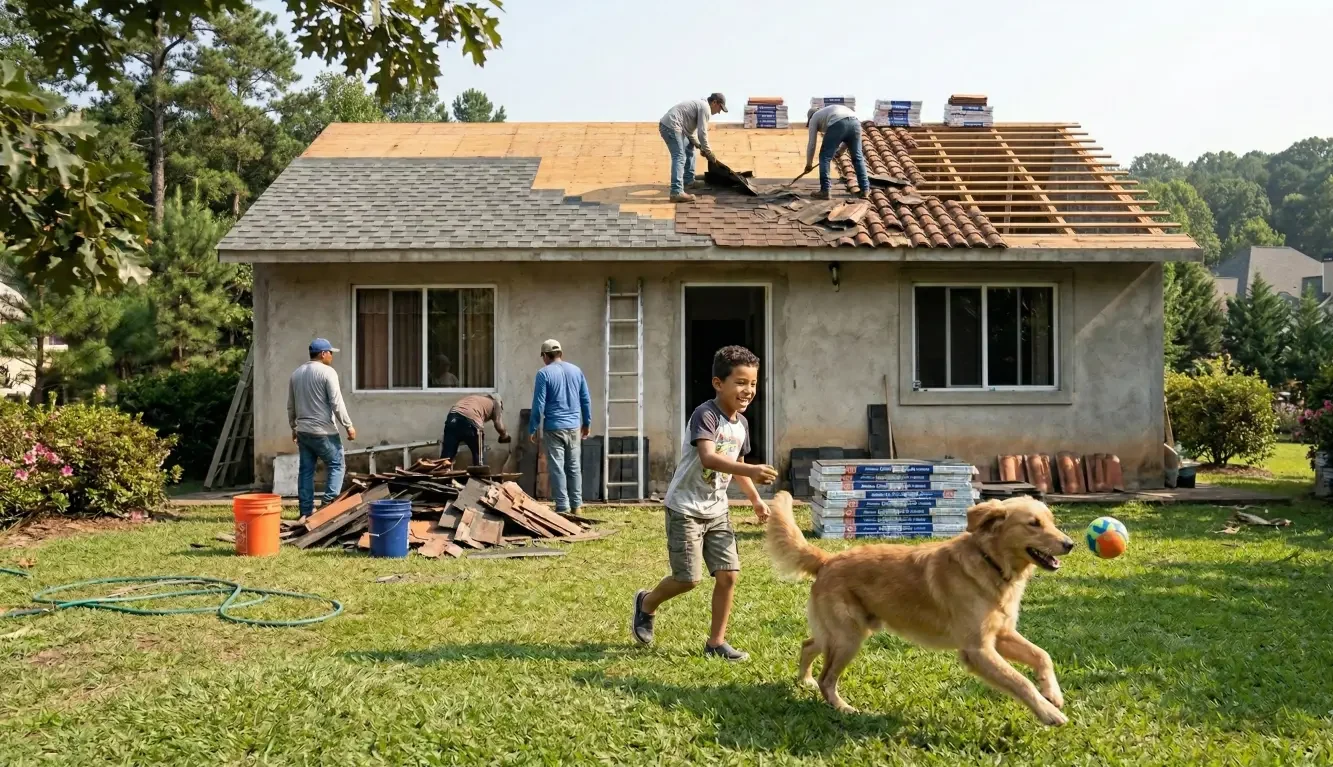
Roof replacement is loud, unfamiliar to animals, and disruptive to routines—especially nap schedules and school pickup windows. The stress usually isn’t the roof itself; it’s the feeling that your house becomes a jobsite you can’t control for a day. If your install date is coming up and you’re already picturing barking, hiding, door-dashing, or a baby who won’t settle, you’re not overreacting—you’re planning like someone who knows how fast a normal day can go sideways.
The good news is that most of the chaos is preventable when you treat roof replacement like a one-day “event” you can stage: set expectations, control movement, and coordinate the timeline with your roofer. These five steps are built for real family life—pets who startle, kids who want to watch, doors that open constantly, and schedules that matter.
How to make a better roof replacement with pets and kids.
What makes roof replacement stressful for pets and kids (and what you can control)
Before the checklist, it helps to name the problem clearly. Families don’t struggle because the crew is working. They struggle because the work changes the rules of the house for a day: unfamiliar sounds, unfamiliar people, and constant motion at the exact moment you need calm and predictability.
Why tear-off noise is different than “normal construction”
Many home projects are noisy, but roof replacement has a few qualities that can hit pets and kids harder:
- The noise is overhead and percussive. It’s not a distant drill in a room you can close off; it’s impact noise that carries through the whole structure.
- The sound pattern is unpredictable. Long quiet stretches can be followed by sudden bursts. That’s stressful for anxious dogs and startling for young kids.
- Vibration and movement feel “close.” Even if the crew is professional and careful, the house can feel different when there’s activity on the roof.
- There’s a lot of coming and going. Doors open, workers move around the property, and the usual “keep the gate shut” routine can slip if you don’t plan for it.
If you’ve ever watched your dog react to thunder, you can imagine why roof noise can be challenging—even if the work only lasts a day.
The controllables: space, sound, supervision, schedule, communication
You can’t make roofing silent. You can control the conditions that turn noise into chaos:
- Space: where pets and kids are allowed to be—and where they aren’t.
- Sound: how much of the noise reaches your “quiet zone,” and whether you mask the sharpest peaks.
- Supervision: who is responsible for kids and pets during peak activity (and when you switch).
- Schedule: timing naps, school runs, and “out of the house” windows around the loudest periods.
- Communication: a clear plan with your roofer so you’re not guessing what happens next.
The checklist below is built around those controllables.
The 5-step calm-and-safe checklist (start here)
If your roof replacement is scheduled, the simplest way to reduce stress is to decide your rules ahead of time. These steps work best when you do them in order—because each one makes the next one easier.
Step 1 — Set up one “quiet zone” with a door and sound buffer
Pick one room with a real door (not an open floor plan corner) and treat it as the day’s calm center. You’re not aiming for perfect silence—you’re aiming for “less intense.”
A good quiet zone usually has:
- A door that closes fully
- Fewer exterior-facing windows (if you can choose)
- Space for a crate, baby monitor, or comfort items
- Access to a bathroom (nice-to-have, not required)
Then set it up like you mean it:
- Bring in water, snacks, diapers, toys, chews—whatever your household needs so you’re not constantly leaving.
- Add familiar items for pets: a bed, a worn blanket, a favorite toy.
- If you use a crate, set it up in advance (not for the first time on install day).
One underrated detail: decide where the “quiet zone” is before the crew arrives, so you aren’t moving things while doors are opening and people are walking through the property.
Step 2 — Plan your “out of the house” window for peak noise
For many families, the calmest solution isn’t tougher soundproofing—it’s simply being somewhere else during the loudest window.
This doesn’t have to mean leaving all day. It can mean:
- Taking pets and kids to a park, a friend’s house, or a parent’s home
- Scheduling errands, school drop-off, or a long breakfast during peak activity
- Booking a short “field trip” during the time you expect the most overhead pounding
How long should you plan to be out? Your roofer may not guarantee exact minute-by-minute timing, but you can usually ask for a realistic “peak noise” window based on the day’s plan. If your pet is highly sensitive—or if you have a baby who naps lightly—plan to be out during the noisiest period even if it feels inconvenient. It’s often the single best stress-reducer.
A simple way to frame it: “We’re not leaving because we can’t handle it. We’re leaving because it’s the easiest way to keep the house calm.”
Step 3 — Create a kid/pet traffic plan (doors, gates, drop zones)
Most safety issues on install day don’t happen because someone does something reckless. They happen because normal routines break down:
- A door stays open a little longer than usual.
- Someone is carrying something and can’t close a gate immediately.
- A child wants to watch.
- A dog hears a sound and bolts.
Create a traffic plan with three parts:
1) Door rule: choose one exterior door as the “active door.”
- That’s the door adults use.
- All other exterior doors stay locked or taped with a reminder note.
- If you have an indoor/outdoor cat, install day is an “indoor only” day.
2) Drop zone: choose a single spot where deliveries, backpacks, and shoes go.
This reduces wandering in and out and keeps you from opening doors repeatedly.
3) Kid boundary: pick an indoor boundary line.
Whether it’s a baby gate, a closed hallway door, or a “no going past the foyer” rule, define it in advance. Kids don’t need to see roofing work up close. They need a clear boundary that’s easy to follow.
If you have multiple adults at home, assign roles: one person is “kid lead,” one is “pet lead.” If you’re solo, make the quiet zone and door rule even more important.
Step 4 — Confirm the job timeline with your roofer (so naps/school don’t get blindsided)
Families get stressed when they’re guessing. You don’t need a perfect schedule—you need a working map of the day.
The day before, ask for:
- Start time (arrival time and “work begins” time)
- The rough sequence (setup → removal → install → cleanup)
- The likely window for peak noise
- When the driveway and primary entry will be most active
- End-of-day cleanup timing
Then share your constraints politely and clearly:
- “We have a baby nap window around 1:00.”
- “We have school pickup at 3:00 and a dog who door-dashes.”
- “We’ll be out from 10:30 to 1:30 if that aligns with the loudest part.”
Good contractors appreciate this because it reduces friction and surprises. A clear plan makes it easier for everyone to work smoothly.
Step 5 — End-of-day safety sweep: what to ask for and what to check
For families with pets and kids, the job isn’t “done” until you feel safe letting the dog back into the yard and the kids back into normal play.
Before the crew leaves, ask:
- Where debris was staged and removed from
- What cleanup steps were used to reduce nail and material leftovers
- Whether there are any areas you should avoid temporarily (for example, a side yard used for staging)
Then do your own quick sweep with a family lens:
- Check the main walking paths: driveway, porch steps, the door you use most
- Scan the yard edges and anywhere your dog sniffs or runs
- Look under bushes and along fences (small debris likes to hide there)
This isn’t about distrust. It’s about recognizing that pets and toddlers experience the world at ground level.
Noise management that actually helps (without overpromising silence)
Noise is the main stress trigger—but the goal isn’t to eliminate it. The goal is to lower intensity and reduce startle spikes.
Simple sound-masking ideas that don’t require special equipment (TBD: specifics to verify)
Most households already have tools that can help create a calmer environment:
- A steady background sound (like a fan or a consistent audio track) in the quiet zone
- Curtains or blankets to soften the room’s “echo”
- A familiar routine in the quiet zone (same toy bin, same snack, same nap cues)
For pets, consistency matters more than “perfect.” A predictable environment with fewer sharp sound changes can reduce stress for many animals, but responses vary. If your pet has a history of severe noise anxiety, it may be worth asking your veterinarian for personalized guidance well before install day.
When leaving the house is the kindest option (and how long to plan)
There’s a common belief that you should keep pets home so they “get used to it.” For many animals, that’s not how it works. If the noise triggers panic, prolonged exposure can make future noise sensitivity worse, not better.
If you have:
- A dog who shakes, pants heavily, hides, or tries to escape during storms
- A pet with a history of destructive behavior when startled
- A baby who naps lightly and reacts strongly to sudden noise
…plan an “out of the house” window during the noisiest portion of the work. Even a few hours can change the whole day.
Safe spaces and containment: crates, rooms, and backyard rules
The next big stress source isn’t noise—it’s movement: workers around the property, doors opening, and a yard that temporarily becomes a work zone.
Preventing door-dash: “every exterior door stays locked” rule
Door-dashing is the most common preventable hazard with pets during home projects. Install day is not the day to rely on “we’ll be careful.”
Use a simple rule: every exterior door stays locked unless an adult is actively using it.
That means:
- No propping doors open “for airflow”
- No letting kids run in and out while the crew is present
- No quick “just for a second” trips to the car without checking where the dog is
If your dog tends to bolt, add redundancy:
- Keep a leash near the active door
- Use a baby gate or closed hallway door as a second barrier
- Keep ID tags on, even if the pet is normally indoors
The goal is to make escapes difficult even if someone makes a normal human mistake.
Yard access: when it’s safe and when it’s not (ladders, falling debris)
Even if your yard is fenced, roof work changes what’s safe outside:
- Ladders may be placed near fences or gates
- Materials can be carried across yard zones
- Small debris can fall unexpectedly during active work
A practical rule: during active roof work, pets and kids stay inside unless you’re leaving the property.
If your dog needs a bathroom break, use a leash and a controlled route. Treat the yard like a temporary work zone, not a play area.
Scheduling around naps and school: how to ask for a family-friendly plan
Families often feel hesitant to mention naps or school pickup because it sounds “soft.” But this is about logistics and safety, not comfort.
What to ask the day before (start time, tear-off window, cleanup window)
Use a short, direct message or call:
- “What time do you arrive and what time does work start?”
- “What’s the rough sequence of the day?”
- “When is the loudest part likely to happen?”
- “When should we expect the most movement around the doors/driveway?”
- “When does cleanup happen and what does that include?”
If you need to align with school and naps, it’s okay to ask:
- “If we plan to be out from X to Y, does that match the loudest window?”
- “Is there anything we should do to keep the entry path clear and safe?”
A realistic expectation reset: what can and can’t be guaranteed
A good roofer can give you a dependable plan, but there are limits:
- Weather can shift timing
- Hidden roof conditions can create surprises
- Cleanup is thorough, but families should still do a quick sweep
What you can reasonably expect is communication: a clear start time, a general sequence, and a crew that respects boundaries and safety.
If a contractor can’t answer basic timeline questions—or doesn’t seem interested in the realities of a family household—that’s useful information.
Staying home isn’t always the “brave” choice
A lot of homeowners try to power through install day with everyone at home because it feels simpler. Sometimes it is. Often it isn’t.
Why forcing an anxious pet to “get used to it” can backfire
For some pets, exposure works. For others, intense noise triggers panic responses:
- Escape attempts
- Destructive behavior
- Refusal to eat or drink
- Persistent stress that lasts after the noise stops
If your pet is already anxious, “getting used to it” may not happen in one day. A calmer plan is usually gentler for everyone.
If you’re unsure how your pet will react, it can help to plan a backup: a friend’s house, a daycare option, or an adult who can leave with the pet if needed.
A calmer plan often means temporary relocation during peak noise
A realistic, low-stress version of install day might look like this:
- Morning: setup quiet zone, confirm timeline, do breakfast as normal
- Midday: leave the house with kids/pets during peak noise
- Afternoon: return when the noise has settled into a steadier rhythm
- End of day: do a quick safety sweep before letting the dog run the yard
You don’t need to disappear all day. You just need to avoid the hours that trigger the most stress.
Common mistakes families make on install day
Most “bad days” aren’t caused by one major problem. They’re caused by small decisions stacking up.
“We’ll just keep the dog in the living room”
Living rooms are often central and exposed to the loudest sound. They also tend to be near front doors—exactly where movement and door openings happen.
A better approach is a closed-room quiet zone away from the main entry, with a second barrier if your dog is a door-dasher.
Kids outside watching / doors opening constantly
Kids are curious. Roof work looks exciting. But keeping kids outside to watch increases risk and increases door openings—both of which raise stress for pets.
If kids want to understand what’s happening, explain it from inside:
- “The roof is getting replaced. It’s loud. That’s normal.”
- “We stay in our safe area today.”
- “When the workers are gone, we can look from the window.”
Clear rules beat constant negotiations.
Not coordinating parking and entry points with the crew
On install day, driveways become active zones. If you’re trying to weave around trucks while carrying a baby and keeping a dog from bolting, stress skyrockets.
Ask the day before:
- Where the crew plans to park
- Which door they’ll use (if any)
- Where materials and debris will be staged
Then adjust your family routine around that plan.
How to verify your roofer is running a family-safe jobsite
Homeowners often choose roofers based on price and timing. For families with pets and kids, jobsite discipline matters just as much.
What “property protection + cleanup” should look like
You’re looking for signs of structure:
- Clear staging areas
- Careful movement around landscaping and entry paths
- A cleanup plan that’s more than “we’ll pick up after ourselves”
- A crew that respects boundaries and communicates before opening gates or using side yards
You don’t need to know the technical details of roofing to evaluate jobsite professionalism. You need to see that the contractor runs a process.
Questions to ask: debris control, nail sweeping, designated crew entry
Use simple, practical questions:
- “How do you control debris and protect walkways?”
- “What’s your cleanup routine at the end of the day?”
- “Do you do a final pass for small debris that could affect kids or pets?”
- “Which entrance should we treat as the crew entrance, so we can keep other doors locked?”
- “Where will the dumpster or trailer be placed?”
If the answers feel vague, that’s a signal. If the answers are specific and calm, that’s reassuring.
Book an inspection and ask for a family-safe install plan
If your roof replacement is coming up and you’re worried about pets or little kids, stress usually drops when you stop guessing. A documentation-led process gives you clarity: what’s being done, how the day will flow, and what to expect.
What a documentation-led process adds (clarity, timeline, expectations)
A structured inspection and planning conversation can help you:
- Understand the project scope and day-of sequence
- Identify likely peak noise windows
- Decide where the crew will enter and stage materials
- Plan your quiet zone and “out of the house” window
You’re not just preparing your roof—you’re preparing your household.
Schedule a free roof inspection + install-day plan walkthrough
If your roof work is scheduled and you’re worried about pets or little kids, a clear install-day plan lowers stress fast.
Schedule a free roof inspection and we’ll walk through the day’s timeline, entry points, and cleanup plan—before the crew arrives.
You’ll get photo documentation, realistic timing windows, and a safety checklist you can use with your household.
Book your inspection and let’s make install day calmer and safer.
FAQ content
1) How loud is roof replacement for pets and kids?
It’s typically loud enough to be disruptive, especially during removal of old materials and other high-impact steps. The noise can feel unpredictable because it comes from overhead and may happen in bursts. Planning a quiet zone and an “out of the house” window during the loudest period helps most families.
2) How can I keep my dog calm during roof replacement?
Start with a closed-room quiet zone away from the main entry and add steady background sound to reduce startle spikes. Keep exterior doors locked except for one “active door,” and use a second barrier like a baby gate if your dog tends to bolt. If your dog has severe noise anxiety, consider asking your veterinarian for personalized guidance ahead of time.
3) Is roof replacement too loud for babies or nap time?
It can be, especially for light sleepers. Rather than trying to force naps through peak noise, plan around the loudest window by leaving the house or shifting nap timing if possible. A quiet zone plus consistent background sound may help, but it won’t eliminate overhead impact noise.
4) Should kids stay home during roof work?
Many families choose to keep kids away during the loudest and most active part of the day, especially toddlers who may struggle with boundaries and safety rules. If kids are home, set a clear indoor boundary, keep doors locked, and avoid letting them watch from outside near the work zone.
5) How long should we plan to be out of the house during tear-off?
The exact timing varies by project and weather, but many homeowners plan to be out for a few hours during the noisiest portion of the day. Ask your roofer for a realistic “peak noise” window based on the day’s sequence, then plan errands, school runs, or a visit with family during that period.
6) What should I ask my roofer to do for cleanup and safety with kids/pets?
Ask about their end-of-day cleanup routine, how they control debris, and what steps they take to reduce leftover small debris that could affect kids or pets. Also ask which entrance the crew will use and where materials/debris will be staged so you can keep other doors locked and keep children away from active zones.
If your roof work is scheduled and you’re worried about pets or little kids, a clear install-day plan lowers stress fast.
Schedule a free roof inspection and we’ll walk through the day’s timeline, entry points, and cleanup plan—before the crew arrives.
You’ll get photo documentation, realistic timing windows, and a safety checklist you can use with your household.
Book your inspection and let’s make install day calmer and safer.