
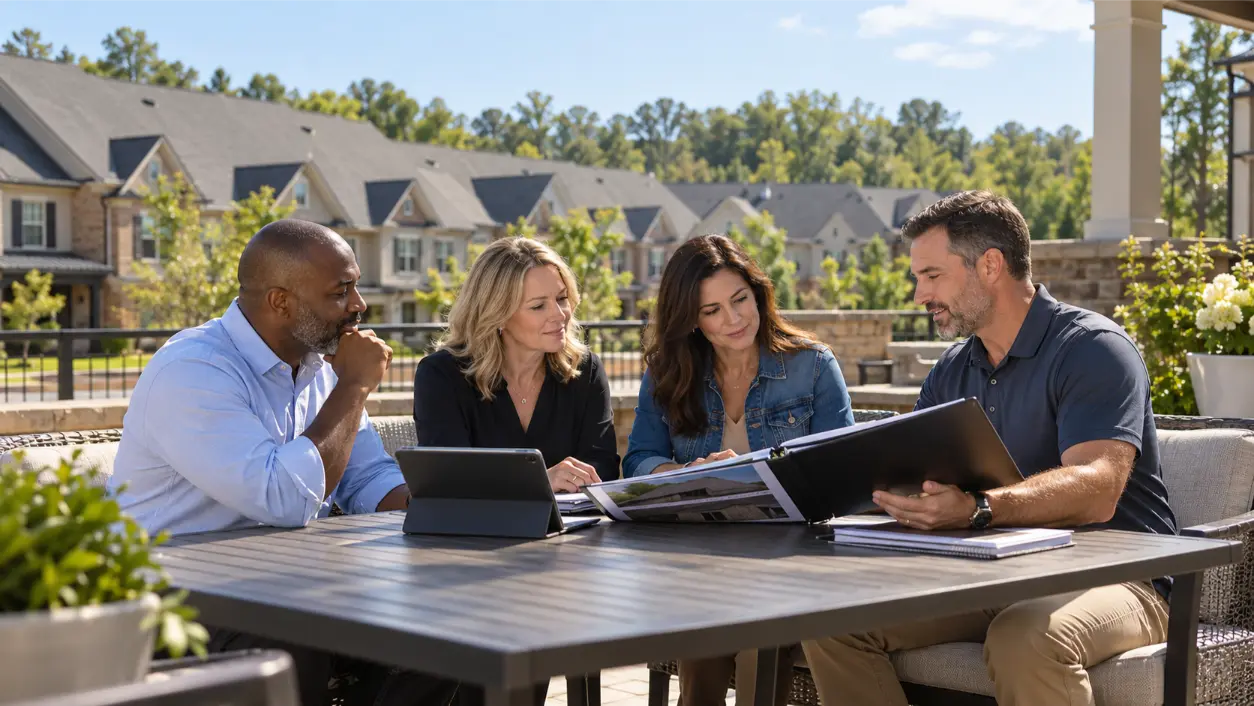
Understanding HOA roof replacement rules after storm damage is about more than choosing new shingles.
When homeowners report missing shingles, leaks, or hail impacts across a community, the board must determine who controls the roof, who must maintain it, what insurance may respond, and how any work will be approved and funded. Those answers may differ between detached-house neighborhoods, townhome developments, and condominiums. A calm, documented process is more reliable than assuming that every roof is the association’s responsibility—or that every storm loss requires replacement.
Start With the Documents, Not the Roof Estimate
An HOA can regulate a roof’s appearance without owning or maintaining that roof. Architectural guidelines may restrict shingle color, materials, or installation details, while the individual lot owner remains responsible for the physical repair. In another community, the association may maintain connected townhome roofs or an identified common building. Condo associations can have different statutory and contractual duties again. A board should not apply one neighborhood’s rules to another.
Before assigning a bill or promising repairs, read the recorded declaration and amendments, bylaws, maintenance exhibits, insurance provisions, and architectural guidelines together. Identify whether the damaged roof is a common element, limited common element, association-maintained component, or owner responsibility. The declaration’s definitions and any plats or unit-boundary descriptions often matter more than an informal explanation inherited from a prior board.
Why Georgia association types matter
Georgia’s Property Owners’ Association Act recognizes authority and obligations through the governing instrument and applicable law; not every neighborhood association has identical duties. The Georgia Condominium Act and Property Owners’ Association Act contain provisions for different qualifying types of associations, including condominium property-insurance requirements addressing roofs and other building components. Those condominium provisions should not be presented as universal rules for detached-house HOAs. When the documents are unclear, have qualified Georgia association counsel review them before the board makes a binding ownership, assessment, or coverage decision.
Who Pays for Roof Damage in an HOA?
The answer comes from a combination of responsibility for the component, the event that damaged it, applicable insurance, deductible allocation, and any authorized assessments. A community’s architectural approval process does not itself establish who writes the repair check. Likewise, an association master policy does not necessarily cover every owner-controlled roof or every type of damage.
Detached homes with HOA design rules
In many detached-home neighborhoods, owners maintain their own roofs but obtain architectural approval for changes in color, product, or appearance. Following a hailstorm, the board may need to distribute approved material standards and explain the application process, rather than organize a single replacement contract. Verify the actual declaration before describing this as the community’s arrangement.
Townhomes with shared or continuous roof systems
Townhomes can be harder. A continuous roofline may cross property boundaries, and water entering one unit may originate above another. Some declarations place the roof with the association; others allocate repair obligations to owners or divide responsibilities by component. Ask the association attorney and roofing professional to clarify the maintenance map before allowing fragmented repairs that may create new flashing or drainage problems.
Condominiums and insured building components
For condominiums governed by Georgia’s Condominium Act, O.C.G.A. § 44-3-107 addresses association property insurance, including roofs and roof structures. That does not mean every loss is covered without limitation or that a unit owner never faces costs. The declarations, deductible provisions, policy language, and actual cause of loss remain relevant. The board should confirm its duties with counsel and the association’s insurance professional instead of translating the statute into an unconditional payout promise.
A Board-Level Roof Responsibility Matrix
At the next board meeting, create a simple list of each building or roof section. Record the responsible party for routine maintenance, storm inspection, repair approval, replacement funding, insurance notification, and deductible review. Include the document section supporting each assignment. Where an answer remains disputed, label it unresolved and obtain advice instead of circulating a guess as policy.
- Asset: building address, roof section, roof type, approximate installation date, and available warranty records.
- Duty: who inspects, maintains, authorizes, and funds repairs under the documents.
- Insurance: association master policy, owner policy, or a combination requiring professional review.
- Approval: applicable architectural standards, emergency authority, contract approval, and owner notice.
- Evidence: previous roof reports, dated photographs, repair history, and the source of each conclusion.
This matrix is an administrative tool, not a legal interpretation. Its value is keeping the board from deciding responsibility from memory while residents await an answer.
Plan for Roof Replacement Before Storm Season
Connect inspections to reserve planning
Reserve planning works best when the community knows what it owns and expects to replace. An inventory of association-maintained roof areas, dates, materials, condition reports, recurring repairs, and potential replacement scopes can support budget discussions. A periodic reserve study or professional update may help estimate future capital needs, but projections are planning assumptions—not a warranty about the precise year a roof will fail.
Do not fund roof replacement solely from an insurance assumption. Storm losses depend on covered causes, deductibles, exclusions, policy limits, and findings after the event; normal aging and deferred maintenance may not be covered. Ask the association’s financial and insurance advisers to test the reserve plan against plausible out-of-pocket costs, including temporary protection, inspections, professional services, and deductible obligations.
Set a roof inspection schedule the board can repeat
Consider using a consistent professional inspection template for roofs within the association’s maintenance scope. Record visible shingles or membrane conditions, flashing, drainage, penetrations, roof edges, attic evidence where access is authorized, and previous repairs. Establish routine intervals based on professional advice and roof condition, with an additional targeted inspection after significant weather. Do not direct volunteers or residents to climb roofs.
For boards reviewing potential storm impacts, a claim-ready roof inspection framework can illustrate why labeled photographs and a repair scope are more useful than a quick visual guess. Red Top Roofing & Exteriors uses an inspection-first process that documents roof conditions for decision-making.
What to Do When Multiple Owners Report Damage
1. Establish a single reporting channel
Ask owners to report their address, date the issue appeared, observable symptoms, and safe ground-level or interior photographs. Separate active leaks from cosmetic concerns and unverified hail reports. Use one log managed by a designated board or management contact so that a duplicate report does not become a separate, contradictory work order.
2. Protect property and respond to urgent hazards
Water entry, fallen material, unsafe electrical conditions, and damaged overhead structures deserve prompt professional assessment. The board should coordinate temporary measures for components under its control; owners should be directed to the appropriate contact for owner-maintained components. Georgia’s insurance regulator advises documenting damage, contacting the insurer promptly, preserving receipts, and protecting property from additional harm. Avoid making major permanent changes that interfere with an insurer’s inspection without discussing the situation with the carrier.
3. Inspect representative areas, then expand as warranted
One damaged slope does not prove that every building needs a new roof. Conversely, a few dry interior ceilings do not establish that all roof surfaces survived intact. Have a qualified roofing professional document conditions building by building or by logical roof zone. Note differences in age, material, orientation, exposure, and preexisting wear. Ask inspectors to distinguish observed storm effects from maintenance conditions and uncertain findings.
4. Coordinate insurance notifications without promising coverage
Determine who is authorized to report a loss under the applicable policy, what notification requirements apply, and what materials the adjuster needs. The association’s master insurer and owners’ carriers may have different roles depending on the property arrangement. A roofing contractor can explain roof conditions and proposed construction work, while an insurer evaluates coverage under its policy. Keep communication with both sides factual and in writing.
5. Approve a consistent repair or replacement plan
Once inspections and responsibility questions are resolved, compare proposed repairs against replacement where applicable. Review the condition of decking, flashing, underlayment, ventilation, drainage, and manufacturer requirements. Ask for itemized scopes and confirm whether connected roofs need coordinated details. Red Top’s guide to roof replacement versus repair after a storm offers a useful starting point for discussing those technical tradeoffs.
Roofing Guidelines for Townhomes: Consistency Without Guesswork
Townhome communities often want a uniform appearance, but consistency should be implemented through documented, lawful standards. If owners are permitted to replace their own roofs, communicate the current approved products, colors, submission forms, contractor documentation requirements, and review timelines. If the association controls the roof system, explain why owners should not independently authorize modifications that compromise shared details.
Following widespread damage, boards may need a temporary administrative pathway for urgent repairs while permanent aesthetic approvals proceed. Any emergency exceptions should come from the actual declaration or validly adopted procedures. The board should also plan how to handle older roof colors that are no longer available and material substitutions approved by manufacturers or local authorities. Do not imply that matching every shingle is always technically possible.
Build a Clear Storm Communication Plan
Residents need to know who to call, who may inspect their roof, and what decision is still pending. A short written update should explain the board’s present understanding of responsibility, the next inspection date or expected scheduling process, safe reporting instructions, and the fact that insurance decisions have not yet been made. Avoid circulating rumors about a guaranteed community-wide replacement or an imminent special assessment.
For multi-building projects, provide advance notice of expected noise, access restrictions, debris handling, parking impacts, and work sequence. Require the contractor to explain property-protection and cleanup procedures, and record how owners can raise concerns during work. Red Top describes its free roof inspection process as including photographs, a written scope, and planning for property protection.
Board Meeting Checklist: Decisions to Make Before the Next Storm
- Locate the latest declaration, amendments, maintenance maps, and architectural standards.
- Identify which roofs, if any, the association maintains and which require owner action.
- Review association and owner insurance roles with qualified insurance professionals.
- Update the roof inventory, condition history, and replacement planning assumptions.
- Agree on who can authorize inspections, temporary protection, and contracts.
- Create a common photo-report template and one resident reporting channel.
- Set a communication process for roof access, claim updates, approvals, and work schedules.
- Document unresolved legal or financial questions for counsel and advisers.
The board can assign owners and deadlines for each item, then revisit the checklist annually or when the community’s roof and insurance conditions materially change. Consistent records are especially useful when board membership turns over.
Frequently Asked Questions
Who pays for roof damage in an HOA after a storm?
Payment depends on governing documents, the roof’s legal status, insurance arrangements, cause of damage, and any deductible or assessment rules. Some associations maintain shared roofs; many detached homeowners maintain their own. Do not treat architectural approval as proof that the association pays.
Is an HOA responsible for a leak in a townhome roof?
Possibly, but not automatically. The declaration may assign the roof to the association, the owner, or different parties for different parts. The source of the leak and the applicable insurance may also require investigation. Ask a qualified roofer to locate the problem and counsel to interpret disputed duties.
Can an HOA require a specific roof color or material?
Many associations enforce lawful architectural restrictions under their recorded instruments, but the scope and procedure vary. Board members should consult the actual standards and approval provisions, including any applicable emergency or variance process, before issuing directives.
Should an HOA file an insurance claim for every hailstorm?
No automatic rule fits all communities. The authorized policyholder should review documented damage, coverage provisions, deductibles, policy requirements, and professional guidance before deciding how to proceed. Reporting obligations and claim-filing choices should not be assumed to be identical.
How often should an HOA schedule roof inspections?
Use a schedule informed by roof type, age, condition, manufacturer guidance, prior repairs, and qualified professional recommendations. An additional inspection after a substantial storm may be appropriate for association-maintained roofs. A uniform calendar date alone does not establish roof health.
Get the Facts Before the Board Commits to a Roof Plan
The strongest HOA roofing process is not the one that promises the fastest vote. It is the one that establishes responsibility, produces consistent inspection evidence, tests the budget against real obligations, and tells residents what happens next. Red Top Roofing & Exteriors serves Atlanta, Cartersville, Roswell, Marietta, Acworth, Woodstock, and surrounding Georgia communities with documentation-focused roof inspections and replacement planning. If your board is evaluating reported storm damage, request a free roof inspection to establish a clearer technical starting point before choosing a repair or replacement scope.
Disclaimer: This article offers general educational information, not legal, insurance-coverage, financial, engineering, or construction advice. HOA and condominium responsibilities, reserve and assessment powers, insurance terms, and roof safety requirements depend on governing documents, current law, policy language, and property conditions. Consult association counsel, insurance advisers, and qualified roofing professionals for decisions affecting your community.
RELATED LINK: Georgia Office of Commissioner of Insurance and Safety Fire — Insurance Claim Tips