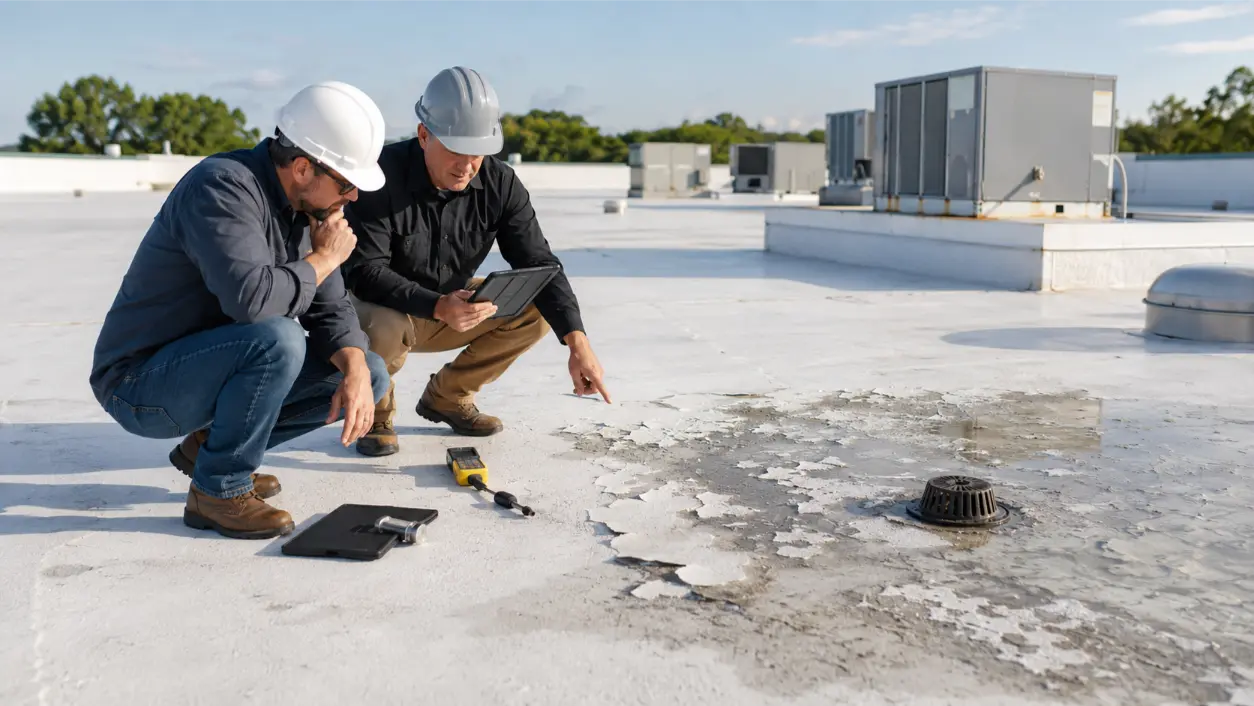
If you are asking why did my roof coating fail early, the peeling, blistering, cracking, or worn areas you can see are only the starting point. Premature coating problems can come from the condition of the existing roof, surface contamination, trapped moisture, incompatible materials, skipped primer or adhesion testing, unresolved drainage, incorrect film thickness, poor detailing, or weather during installation. The right response is not to assume the coating itself was defective. It is to reconstruct what was installed, how the roof was prepared, and what conditions the system has been exposed to since application.
Commercial roof coatings can be effective restoration tools when the existing roof is a suitable candidate and the selected system is installed to its manufacturer requirements. They are not a substitute for repairing a failing substrate, wet insulation, active leaks, bad drainage, or structural problems. That distinction is where many early-failure investigations should begin.
What “Early Failure” Can Look Like
A coating problem does not always appear as one dramatic leak. The symptoms may develop gradually and may affect only certain roof zones.
- Peeling or sheets of coating separating from the substrate.
- Blisters, bubbles, or soft raised areas.
- Cracking around seams, fasteners, penetrations, or transitions.
- Thin or visibly worn areas that expose the surface below.
- Discoloration, staining, or deterioration concentrated where water sits.
- Coating that washes, erodes, or remains soft after installation.
- Recurring leaks even though the roof was recently coated.
1. The Roof Was Not Clean Enough for Reliable Adhesion
Coatings need to bond to the actual roof substrate or an approved primer—not to dust, chalk, grease, loose oxidation, deteriorated old coating, biological growth, or construction residue. GAF’s commercial coating guidance emphasizes that the roof should be clean, dry, and sound before coating. Its installation guidance also calls for cleaning and adhesion testing before full application.
If the new coating bonded to contaminants instead of the roof, the failure may show up as peeling or delamination even though the coating film itself cured normally.
What to verify
- How the roof was cleaned and whether contaminants were removed.
- Whether deteriorated prior coatings, rust, or loose material were addressed.
- Whether test patches were performed after preparation.
- Whether the substrate-specific manufacturer instructions were followed.
2. Moisture Was Trapped Below or Present During Application
Applying a coating over a wet surface or over a roof assembly with trapped moisture can create serious performance problems. Moisture can interfere with adhesion, become trapped below the new membrane, or contribute to blistering and continued deterioration of the underlying roof.
Owners investigating premature failure should ask whether a moisture survey or other condition assessment was performed and what wet materials were replaced before the coating was applied.
3. The Installer Skipped Adhesion Testing or the Required Primer
Compatibility cannot always be judged by appearance. A coating that works well on one roof membrane may require a specific primer, preparation method, or different system on another. This is why manufacturer specifications commonly require or recommend adhesion testing before full application.
If no test patches were completed and large areas are peeling cleanly away from the surface, the original compatibility and preparation steps deserve close review.
4. Existing Roof Defects Were Coated Instead of Repaired
A coating creates a continuous protective layer, but it does not make every existing defect disappear. Open seams, failed flashings, punctures, loose fasteners, deteriorated penetrations, damaged membrane, corroded metal, and active leaks typically need to be repaired and detailed before the field coating is installed.
Manufacturer systems often use sealants, mastics, reinforcing fabric, primers, or substrate-specific repairs at vulnerable details. Simply rolling or spraying field coating across a failed seam is not the same as rebuilding the detail to the system specification.
When coating failure is concentrated at details rather than across the entire field, review how those details were prepared and reinforced.
5. Ponding Water Was Ignored—or the Wrong Coating Was Selected
Ponding water is one of the most misunderstood parts of a coating investigation. Not every coating chemistry reacts the same way to prolonged standing water.
GAF notes that acrylic coatings are generally not the preferred choice where ponding water remains because prolonged exposure can contribute to breakdown and delamination. Silicone coatings, by contrast, are designed to provide stronger resistance to ponding-water exposure. That does not mean drainage can be ignored or that every silicone installation will perform regardless of substrate condition, detailing, or installation quality.
If water routinely remains on the roof after rainfall, determine why. Blocked drains, low areas, settled insulation, inadequate slope, structural deflection, or poor drainage layout can all create ponding. Some drainage conditions may need to be corrected before recoating. In other situations, the manufacturer may allow a coating system that is specifically designed for the expected exposure.
The key question is product-specific
Ask: Was this exact coating system approved for this substrate and this drainage condition? The answer should come from the product data, project specification, manufacturer instructions, and documented installation—not from a generic claim that “roof coatings handle standing water.”
6. The Coating Was Applied Too Thin—or Unevenly
Roof coatings are specified by coverage rate and resulting film thickness. Applying less material than required can leave thin areas with reduced durability, while uneven application can create weak zones around high spots, texture, penetrations, seams, or transitions.
Manufacturer installation guidance commonly calls for checking wet-film thickness or otherwise verifying application rate. Required coverage can also change with the warranty or system configuration. More years of coverage may require more material, additional coats, fabric reinforcement, or other system components.
7. Weather Interrupted the Cure
Temperature, humidity, rain, dew, fog, condensation, and substrate temperature can all matter during coating installation. Different chemistries cure differently. Water-based acrylic products can be especially vulnerable to moisture before they have developed sufficient film, while silicone products cure through reaction with moisture but still require a properly prepared and suitably dry roof surface at installation.
How to Investigate a Failed Roof Coating
Do not start by coating over the failed area. A quick patch can hide the failure pattern and make the root cause harder to document. Instead, build an evidence package.
- Photograph the failure pattern. Capture wide views, medium views, and close-ups. Mark drains, seams, penetrations, equipment, and ponding areas.
- Document when water is present. Take photos after rainfall and note how long water remains in affected areas.
- Identify the exact products. Obtain coating names, primers, sealants, reinforcing materials, batch information if available, and system specifications.
- Collect the original scope. Review cleaning, repairs, moisture work, primer, adhesion tests, coverage rates, number of coats, and warranty requirements.
- Check installation weather. Compare job dates with documented conditions and the product application window.
- Inspect the substrate. Determine whether the failure is at the coating-to-roof interface, within an old coating, within a primer layer, or associated with wet or deteriorated roofing below.
- Review drainage. Map low areas, drains, scuppers, and locations where water remains.
- Compare findings to manufacturer requirements. The selected product’s instructions are more useful than generic coating advice.
Repair, Recoat, or Replace?
Corrective work depends on how much of the existing assembly is still serviceable.
Localized repair may make sense when
The problem is confined to a small number of details, isolated adhesion failures, damaged flashings, or localized drainage issues and the broader roof remains dry and sound.
Recoating may make sense when
The existing coating is generally bonded, the roof remains a suitable restoration candidate, wet materials have been removed, drainage and details are addressed, and the new system is compatible with what remains. The preparation requirements for coating over an existing coating can be different from first-time application.
Replacement may be the better decision when
There is widespread wet insulation, structural deterioration, extensive membrane failure, persistent drainage problems that cannot be corrected within the restoration scope, or a roof that is already beyond reasonable serviceability. A coating can extend the useful life of a suitable roof; it cannot return a fundamentally failed roof to new condition.
Owner Checklist Before Approving Corrective Work
- What exactly failed: coating, primer, old coating, membrane, insulation, or detail?
- What evidence supports the proposed cause?
- Was the roof moisture-tested before the original coating?
- Were adhesion tests performed and documented?
- Was a primer required for the substrate?
- Were leaks, seams, penetrations, rust, and damaged areas repaired first?
- Is ponding present, and is the selected coating approved for that exposure?
- What coverage rate and wet/dry film thickness were required?
- Were weather and cure-window requirements met?
- What manufacturer system and warranty terms applied to the project?
- Does the corrective proposal address the root cause or only cover the symptom?
How Red Top Roofing Can Help Document the Next Decision
Red Top Roofing & Exteriors serves commercial and residential property owners in the Atlanta area and surrounding Georgia communities. GAF currently lists Red Top Roofing & Exteriors as a GAF CoatingsPro™+ Liquid Applied Roofing Contractor, a manufacturer distinction focused on coatings and liquid-applied roofing systems.
If a recently coated commercial roof is peeling, blistering, leaking, or holding water, the useful next step is an evidence-based assessment of the roof assembly, drainage, coating condition, and original system requirements. Red Top’s documentation-led approach can help property owners build a clearer record before deciding whether the next scope should involve localized repair, recoating, drainage correction, or replacement.
Property owners can contact Red Top Roofing to request an inspection and discuss the condition of a commercial roof coating.
Frequently Asked Questions
Why is my roof coating peeling after only two years?
Peeling can be associated with poor surface preparation, contamination, trapped moisture, incompatible materials, missing primer, inadequate adhesion, or another substrate problem. The failure interface and original installation records should be inspected before assigning one cause.
Can ponding water make a roof coating fail?
Yes, depending on the coating chemistry and system. GAF specifically cautions against acrylic coatings where ponding water persists, while silicone coatings are designed for stronger ponding-water resistance. Even with silicone, drainage, substrate condition, details, and manufacturer requirements still matter.
Should a commercial roof be completely dry before coating?
The roof surface should meet the exact product’s preparation requirements, and trapped moisture in the roof assembly should be addressed. GAF’s guidance for restoration systems emphasizes clean, dry, sound roofing and replacement of moisture-saturated materials before coating.
How can I tell whether my contractor followed the manufacturer specifications?
Ask for the exact system specification, product data sheets, primer requirements, adhesion-test results, moisture-survey records, preparation photos, coverage-rate documentation, wet-mil readings if used, installation dates, and warranty paperwork. Compare those records with the current manufacturer requirements for the installed system.
Can I just put another coat over peeling areas?
Not until the cause and extent of the adhesion failure are understood. Coating over unstable material can transfer the same weakness into the new layer. Failed or incompatible material may need to be removed and the substrate re-prepared before corrective coating.
Does early coating failure mean the whole roof has to be replaced?
No. Some failures are localized and repairable; others reveal widespread moisture, substrate deterioration, drainage problems, or poor adhesion. The repair scope should be based on documented condition rather than the age of the coating alone.
This article provides general commercial roofing and building-maintenance information and is not a project-specific engineering, warranty, code, insurance, or legal determination. Roof-coating performance depends on the existing roof assembly, drainage, substrate condition, product chemistry, preparation, installation, environmental conditions, and manufacturer requirements. Have the roof evaluated by qualified commercial roofing professionals and consult the applicable manufacturer before corrective work.
RELATED LINK: GAF — Roof Coating vs. Commercial Replacement: A Guide for Commercial Buildings