Impact Resistant vs Standard Shingles
You’re staring at your roof replacement quote, and there’s one line that keeps grabbing your eye: “Upgrade to impact-resistant shingles.” It clearly costs more than the standard option, and you’ve heard everything from “must-have in our storm belt” to “just an upsell.” If you’ve already searched for impact resistant shingles vs regular and come away more confused than when you started, you’re not alone.
This guide breaks down what impact-resistant shingles actually do, how they compare to regular architectural shingles in North Georgia hail and wind, and how to decide which option fits your roof, budget, and storm risk—without scare tactics or guesswork.
The Real Question Behind “Are Impact-Resistant Shingles Worth It?”
Most homeowners don’t wake up excited to think about shingle ratings. You just want to make one solid decision: when you replace your roof, do you stick with standard architectural shingles or pay more for impact-resistant ones?
On your quote, that choice may be presented as a simple upgrade line item. In reality, it’s tied to a mix of factors:
- How long you plan to stay in your home
- How storm-active your part of North Georgia feels
- How comfortable you are paying more upfront for potential resilience later
- What, if anything, your insurer actually recognizes or rewards
So the real question isn’t “Is Class 4 good or bad?” The question is: Which shingle type fits my risk, budget, and plans?
You’ve probably heard things like:
- “You’re in the storm belt; you’d be crazy not to upgrade.”
- “Nobody on our street did that. Standard shingles are fine.”
- “My neighbor got a discount.”
All of those might be true for the person saying them—and still not the right answer for you.
The goal of this guide is to walk through both options side by side, in everyday language, so you can see where you land on that spectrum and talk through options with a roofing contractor and your insurer using clear, specific questions.
What “Impact-Resistant” and Class 4 Shingles Actually Mean
Let’s strip away the jargon for a minute.
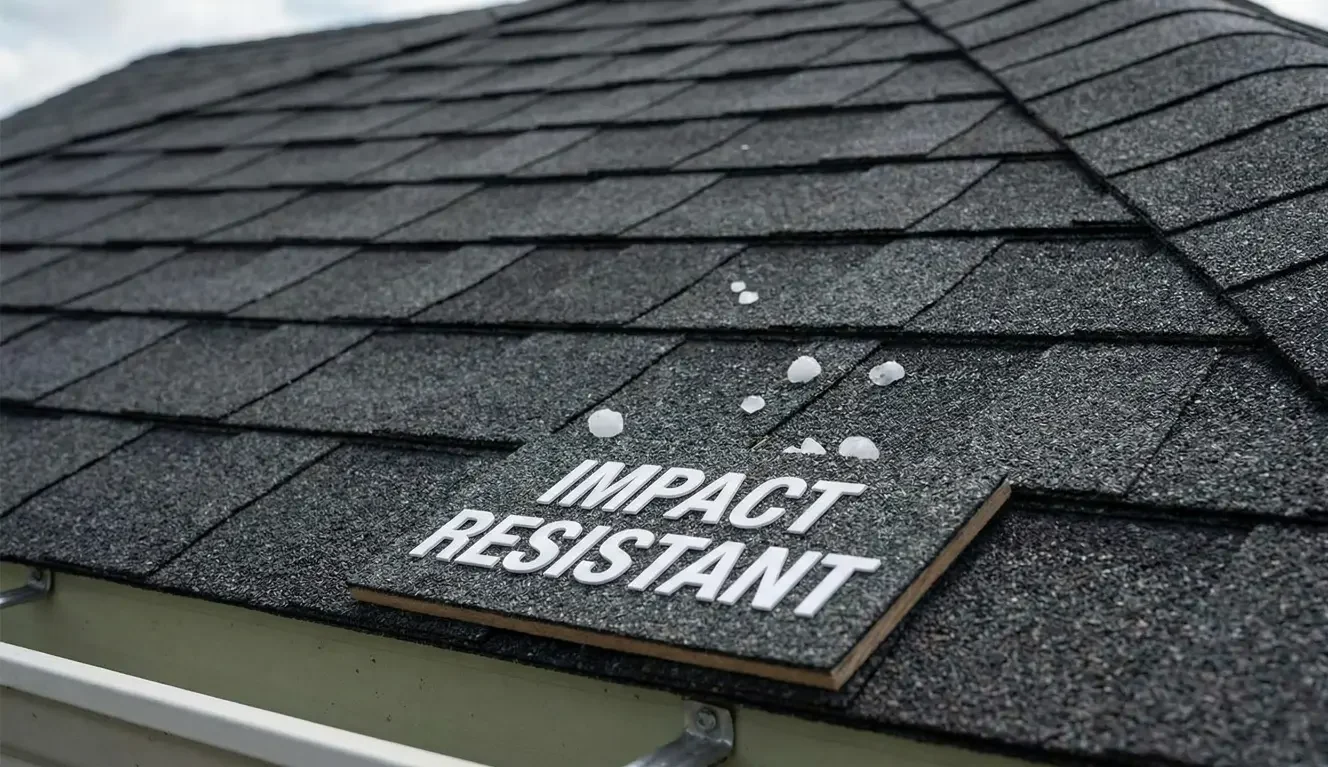
At a high level, impact-resistant shingles are roofing products that are designed and tested to stand up better to certain types of impact—such as hail or wind-blown debris—than many standard shingles. You’ll often hear them referred to as “Class 4” shingles, which is a rating category from an impact test, not a brand name or a specific style.
A few key points to keep in mind:
- Class 4 is a rating, not a look.
Impact-resistant shingles can still be architectural-style shingles that look similar to many standard options from the street. You’re not necessarily signing up for a strange or industrial appearance. - Impact resistance ≠ invincible roof.
The rating is about how the shingle performs under certain test conditions. It does not mean the roof is immune to all hail, all storms, or every kind of damage. - Both systems depend on proper installation.
Whether you choose impact-resistant or standard architectural shingles, the roof still needs to be installed correctly as a whole system—including decking, underlayment, flashing, and ventilation.
From a practical homeowner perspective, it can help to think of it this way:
- Standard architectural shingles are the “baseline” option most people are familiar with.
- Impact-resistant shingles are a step up that are designed and tested for greater resistance to certain types of impact than many standard shingles.
That’s it. No magic armor. No guarantee of a “storm-proof” roof. Just a different product category within the same overall roofing family.
How North Georgia Hail and Wind Factor into the Decision
If you live in North Georgia, you don’t need a weather map to tell you storms are part of life. You’ve probably experienced:
- Strong afternoon thunderstorms that seem to pop up out of nowhere
- Occasional hail events
- Straight-line winds that rattle windows and send branches across the yard
What’s important is not memorizing storm statistics—it’s how those patterns actually show up where you live:
- Some neighborhoods seem to get hit over and over again with hail or strong wind.
- Others see more “glancing blows”—storms pass nearby, but serious roof damage is less common.
- You may already know streets or subdivisions where you’ve seen multiple rounds of tarps and roof replacements over the years.
Hail and wind affect shingles in a few main ways:
- Granule loss: You might see more of the shingle surface wearing down over time.
- Bruising or dents: Even if shingles are still in place, impacts can leave marks that may or may not affect performance.
- Edges and corners: Wind can lift or crease shingles, especially at roof edges, ridges, or around features like dormers and chimneys.
The key point: North Georgia is “storm-aware,” but risk is not identical from block to block.
That’s why the decision between standard and impact-resistant shingles is partly technical and partly personal. It’s about how storm-exposed you feel your specific property is, based on what you’ve seen with your own eyes—and how comfortable you are living with that risk over the next 10–20 years.
Option 1 — Staying with Standard Architectural Shingles
Standard architectural shingles are the workhorse of modern residential roofing. There’s a reason you see them on so many homes across North Georgia.
Advantages of standard shingles
- Lower upfront cost (typically).
In many markets, homeowners find that standard architectural shingles are the more budget-friendly choice compared to impact-resistant products. - Tons of style and color choices.
If curb appeal is a big priority, you’ll find plenty of options that match your home’s look, HOA preferences, or neighborhood style. - Strong performance when installed as a full system.
When paired with solid decking, underlayment, flashing, and proper ventilation, standard shingles can perform very well in everyday conditions.
Tradeoffs to think about
- Potential for more visible hail marks in some storms.
In certain hail events, standard shingles may be more likely to show cosmetic or functional impact marks when compared to impact-resistant options. - May not qualify for certain insurer programs.
If an insurer has a specific program that requires rated impact-resistant products, standard shingles generally won’t meet that threshold. - Long-term risk comfort.
If you plan to stay in a hail-prone pocket of North Georgia for a long time, you may feel less comfortable with the baseline option, especially if you’ve already dealt with storm-related roof issues.
Who standard shingles are often a good fit for
Standard architectural shingles can be a perfectly reasonable choice if:
- You’re on a tighter budget today and need to prioritize immediate affordability.
- You don’t expect to be in the home for decades.
- Your specific neighborhood feels less storm-prone based on past experience.
- You see your roof as something that should be solid and code-compliant, but not necessarily “overbuilt” for storms.
In other words, this option is not “wrong.” It’s simply one end of the spectrum in the impact resistant shingles vs regular decision.
Option 2 — Upgrading to Impact-Resistant / Class 4 Shingles
Now let’s look at the other side of the choice: upgrading to impact-resistant shingles, often marketed as Class 4 products.
Potential advantages of impact-resistant shingles
- Designed and tested for certain impacts.
Some impact-resistant shingles are designed and tested for greater resistance to specific kinds of impact than many standard shingles. Under the right conditions, that can help reduce the likelihood of some storm-related shingle damage. - A more “storm-forward” choice.
For homeowners who have seen multiple hail or wind events around them, impact-resistant shingles can feel like leaning into a more resilience-focused roofing system. - May align with certain insurer conversations.
In some areas, certain insurers may recognize qualifying impact-resistant roofs in their programs. Any potential discount or incentive depends entirely on the insurer and the specific policy, but some homeowners see this as a possible bonus.
Tradeoffs to consider
- Higher upfront investment.
Many homeowners find that impact-resistant shingles come with a higher upfront price than standard options. How much higher will depend on the specific products and scope of work in your quote. - Not a force field.
Even with a higher rating, impact-resistant shingles are not immune to severe storms. Very large hail, falling limbs, or extreme wind can still cause damage. - Discounts are not guaranteed.
Some insurers may recognize impact-resistant roofs; others may not. Programs can change over time. It’s crucial not to make an upgrade decision based solely on something you heard from a neighbor.
Who impact-resistant shingles are often a good fit for
Impact-resistant shingles are often worth serious consideration if:
- You plan to stay in your home for several years (or long-term).
- Your immediate area feels like it is repeatedly in the path of hail or strong thunderstorms.
- You’re comfortable paying more now to potentially reduce certain types of storm-related damage later.
- You’re engaged enough to talk with your insurer and contractor about documentation requirements and long-term implications.
For many homeowners in North Georgia’s storm belt, this option isn’t about chasing a discount; it’s about peace of mind and aligning the roof to the weather they’ve actually experienced.
How Insurance and Potential Discounts Fit into the Shingle Choice
Insurance is often where the conversation gets confusing.
You may have heard:
- “My friend got a discount for putting on Class 4 shingles.”
- “My agent said it doesn’t make a difference with our carrier.”
- “I heard discounts are going away in some places.”
All of those may be true in certain situations. And all of them underline the same reality: insurance is policy-specific.
Here’s a practical way to think about it:
- Some insurers, in some regions, may offer incentives or premium considerations for qualifying impact-resistant roofing systems that are properly documented.
- Others may not offer anything at all.
- Programs can vary, and they can change over time.
Instead of guessing, it’s better to ask very direct questions of your insurer or agent:
- Do you recognize impact-resistant shingles in our area, and if so, which products?
- What documentation would you require from my roofer if I upgrade? (Photos, invoices, product labels, a specific form?)
- Is any incentive tied to the entire roof system being impact-resistant, or just the shingles?
Even if your insurer doesn’t offer a formal discount, some homeowners still upgrade because the potential resilience benefits matter to them. In that case, any future insurance-related advantage would be considered a bonus, not the main reason for choosing the product.
The contrarian takeaway: Choosing shingle grade only for a possible discount can lead to disappointment. It’s more helpful to see any discount as one factor in a bigger picture that includes storm exposure, long-term plans, and how you personally think about risk.
Decision Framework: Which Shingle Type Fits Your Home, Budget, and Timeline?
When you boil everything down, you’re making a choice between two reasonable options, not “good” vs “bad.” A simple set of questions can help you see which direction you lean:
- How long do you realistically plan to stay in this home?
- Less than 5–7 years? Standard architectural shingles may make more sense.
- 10+ years and likely riding out multiple storm cycles? It’s worth taking impact-resistant shingles seriously.
- How storm-active does your immediate area feel?
- Have you seen repeated tarps and roof replacements on your street over the years?
- Or do big hail stories usually seem to be “over there” rather than right on top of you?
- How do you feel about paying more today for potential resilience later?
- If every dollar matters right now, the lower upfront cost of standard shingles could be the deciding factor.
- If you see your roof as a long-term asset and you’re comfortable with an upgrade cost, impact-resistant shingles may align better with your mindset.
- Have you already confirmed what your insurer does or doesn’t recognize?
- A five-minute call with your agent can clarify whether your specific carrier has any programs that might support your decision or not.
- Do you view your roof as minimum requirement or long-term optimization?
- If you’re primarily concerned with meeting code and passing inspection, standard shingles are often just fine.
- If you think of the roof as something you want to optimize for storms because of where you live, impact-resistant shingles may be more appealing.
Putting this together:
- Long stay + higher storm sensitivity + comfortable with higher upfront cost
→ Impact-resistant shingles are often worth serious consideration. - Shorter stay + tight budget + lower perceived risk
→ Standard architectural shingles can be a very reasonable, defensible choice.
There’s no one “correct” answer on paper. There is just the answer that best fits your home, your finances, and your tolerance for North Georgia’s storm personality.
How Red Top’s Inspection-First Process Helps You Choose with Facts
No matter which way you’re leaning, it’s much easier to decide when you’re looking at real information about your roof—not generic examples.
That’s where an inspection- and documentation-led process comes in.
A good roofing partner can:
- Evaluate your current roof and storm history clues.
They’ll look at existing shingles, flashing, decking condition (where visible), and any signs of past hail or wind impacts. - Walk you through shingle options in your context.
Instead of talking about impact-resistant vs standard shingles in the abstract, they can explain how each system would be designed for your roof’s pitch, features, and ventilation needs. - Provide clear, written proposals for both options.
You should be able to see a side-by-side comparison that outlines materials, system components, and scope—not just two prices with product names.
A documentation-first roof inspection and proposal can also:
- Make it easier to talk with your insurer later, if you choose impact-resistant shingles and they want proof of what was installed.
- Highlight other system upgrades that matter just as much as shingle type—such as underlayment options, flashing improvements, or ventilation adjustments.
For homeowners in North Georgia’s storm belt, Red Top Roofing focuses on exactly this kind of process: inspection → documentation → clear options. The goal is to move you from “I hope I’m making the right call” to “I understand what I’m choosing and why.”
When you’re ready to stop guessing and start planning with facts, the next logical step is simple: schedule a free, documentation-led roof inspection and shingle options review for your specific home.
FAQ Content
- Are impact-resistant shingles worth it in Georgia’s storm belt?
They can be worth serious consideration for some homeowners, especially in areas that see repeated hail or strong thunderstorms and where you plan to stay long-term. For others with tighter budgets, shorter timelines, or lower perceived storm risk, standard architectural shingles can still be a reasonable choice. The “worth it” answer depends on your risk comfort, how long you’ll stay, and what your insurer does or doesn’t recognize. - What’s the difference between Class 4 impact-resistant shingles and regular architectural shingles?
Class 4 impact-resistant shingles are designed and tested for greater resistance to certain types of impact than many standard shingles. Regular architectural shingles are the more common baseline option. From the street, both can look similar; the main difference is in how they’re built and how they perform under specific test conditions—not in the basic idea of how they’re installed as part of a roof system. - Do impact-resistant shingles last longer than standard shingles?
They are designed for increased resistance to certain impacts, which may help reduce some kinds of storm-related damage in some situations. That doesn’t automatically mean they will always “last longer” than standard shingles in every scenario. Overall roof longevity still depends on factors like installation quality, ventilation, roof design, and local weather over time. - Will my insurance company discount my premium if I install impact-resistant shingles?
Some insurers in some areas may offer incentives or premium considerations for qualifying impact-resistant roofs, but it’s not guaranteed. Programs vary by company and policy and can change over time. The only way to know for sure is to ask your insurer or agent directly what they recognize, what they require for documentation, and how it would affect your specific policy. - How should I choose the right shingle grade for my new roof in North Georgia?
Start with a few questions: how long you plan to stay, how storm-active your neighborhood feels, how comfortable you are paying more now for potential resilience later, and what your insurer says about impact-resistant products. Then review a clear, written proposal that compares standard and impact-resistant options for your specific roof. That combination of personal priorities, local experience, insurer input, and contractor guidance will lead you to a decision that fits your situation. - Can I mix standard and impact-resistant shingles on the same roof?
In most cases, it’s better to think of the roof as a complete system rather than mixing shingle types. Mixing products could create aesthetic differences and potential questions about performance and documentation later. If you’re considering impact-resistant shingles, it’s usually more straightforward to choose one consistent system and document it clearly with your contractor and, if relevant, your insurer.
You don’t have to guess whether impact-resistant shingles are worth it for your roof.
A documentation-led inspection and side-by-side proposal show how standard and impact-resistant systems compare on your home, in your neighborhood.
Once you’ve seen the options clearly laid out, you can talk to your insurer and make a confident choice—without pressure.
Request your free inspection and shingle options review, and move from “I’m not sure” to a clear plan.
Still weighing shingle grades after a recent storm or inspection note?
Talk with a roofing specialist who understands North Georgia’s storm patterns and can explain how different shingle types fit your budget, storm history, and insurance conversations.
RELATED LINKS
The International Building Code – ICC