
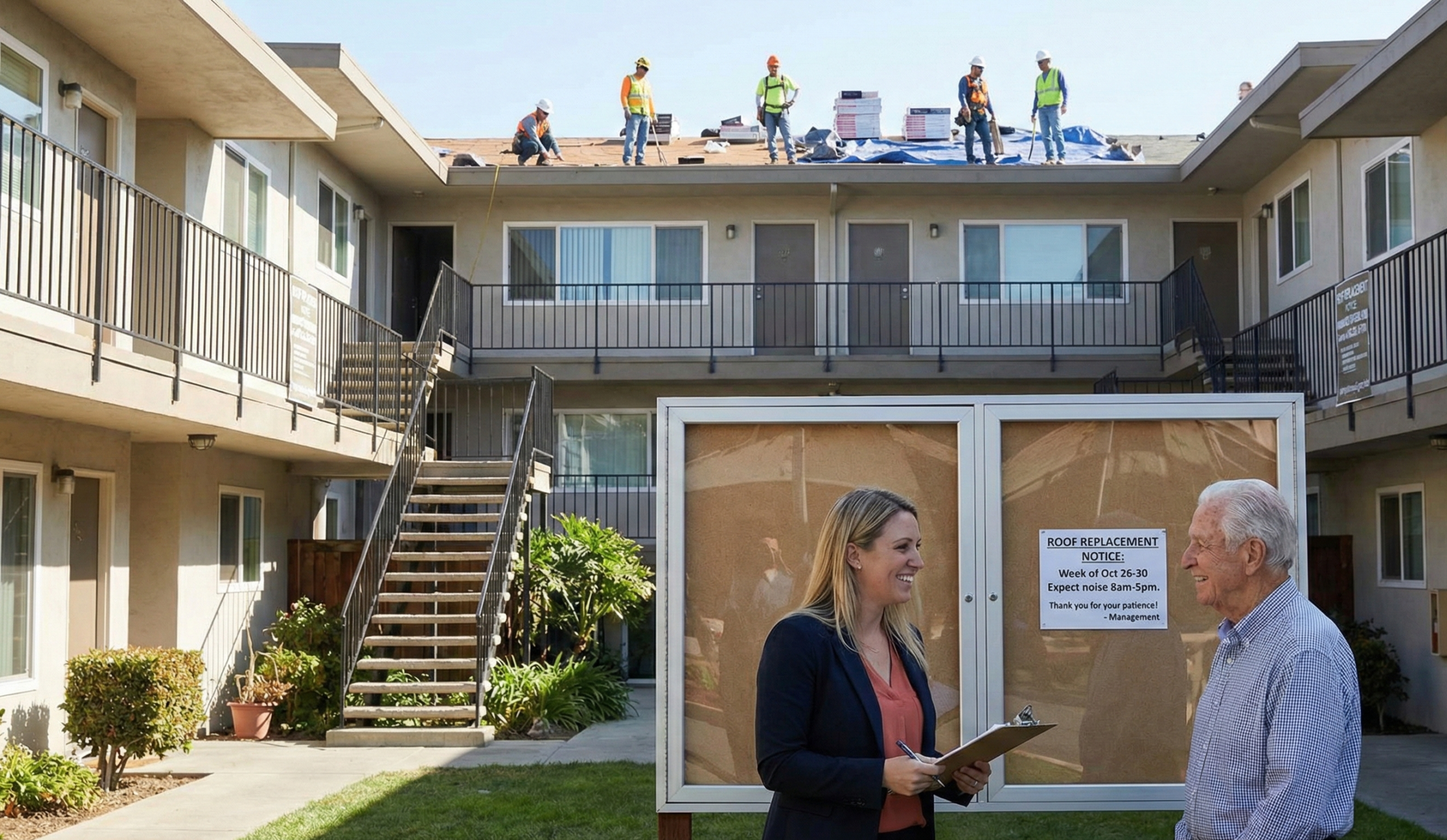
A multi-day roof replacement doesn’t create complaints because tenants are “difficult.” It creates complaints when the plan is invisible. If residents don’t know when noise will happen, where to park, or how debris and safety will be managed, they assume the worst—and your office gets buried in calls, emails, and angry walk-ins.
An important thing to think about is reducing tenant complaints during roof replacement.
If you’re signing a contract for an apartment re-roof, this is the moment to get ahead of it. Not with a single “roof work starts Monday” notice, but with a repeatable communication system: a timeline, a building-by-building schedule, clear expectations, and scripts your onsite team can use to de-escalate problems without improvising.
This guide gives you a practical plan you can run in the real world—multiple buildings, limited parking, residents with different schedules, pets, deliveries, and the day-to-day pressures of keeping an occupied property functioning while work happens overhead.
The real reason tenant complaints spike during roof projects
“Surprise + uncertainty” beats noise every time
Noise is annoying, but it’s rarely the core issue. The fastest route to complaints is when residents feel caught off guard or kept in the dark.
Most resident frustration comes from questions like:
- “Why didn’t anyone tell me my stairwell would be blocked?”
- “Where am I supposed to park today?”
- “Is debris going to hit my balcony or car?”
- “Is it safe to walk my dog outside?”
When those answers aren’t obvious—or when different staff members give different answers—tenants escalate. Not because the work exists, but because the experience feels uncontrolled.
A strong communication plan does two things:
- It reduces surprises by making the plan visible.
- It gives your team a consistent, calm message when surprises still happen.
The three predictable complaint categories: noise, parking/access, debris/safety
In almost every occupied multifamily reroof, complaints cluster into three buckets:
- Noise and disruption
- early morning disturbance, pounding/vibration, fear that “it will last all day,” and concerns for kids, remote workers, or night-shift residents
- Parking and access
- blocked spaces, changing routes, deliveries getting confused, residents feeling singled out (“why our building again?”)
- Debris and safety
- nails, falling material, cordoned-off walkways, balcony/patio mess, pet safety, stroller accessibility, and general fear that the site is unsafe
Your plan should address each category directly—before residents have to ask.
Before day one: set expectations with a simple communication timeline
The goal here is not to flood tenants with paragraphs. It’s to send short, specific messages at the moments residents actually pay attention—then repeat a consistent format so they recognize “this is the update.”
What to send 7–10 days before (and what not to promise)
This is your “big picture” message. It should answer:
- what is happening
- why it’s happening
- the date range (with safe wording)
- how residents will receive updates
- what might change (weather, sequencing)
- what residents should do now (light preparation)
What not to promise:
- exact hourly start/stop times for every day
- a perfect schedule that never shifts
- that there will be “no debris” or “no inconvenience”
Keep it honest and controlled: you’re giving a plan, not a guarantee.
7–10 Day Notice Template (copy/paste)
Subject: Roof Replacement Project — What to Expect Starting [DATE]
Hello Residents,
We’re starting a roof replacement project at [PROPERTY NAME] beginning [START DATE]. This work is important to protect the buildings and prevent future leaks and damage.
What to expect:
- Work will be completed in sections/buildings over multiple days.
- You will hear construction noise during daytime work hours.
- Some parking areas and walkways may be temporarily redirected for safety.
How we’ll communicate:
- We’ll send brief daily updates each morning with the day’s work areas and any parking/access changes.
- Updates will be posted at [LOBBY/MAILROOM/BUILDING ENTRANCES] and sent via [EMAIL/SMS/PORTAL] (TBD).
Safety:
- Please follow posted signage and avoid restricted areas.
- Keep children and pets away from work zones.
We appreciate your patience while this improvement is completed. If you have questions, contact the office at [PHONE/EMAIL].
Thank you,
[PROPERTY MANAGEMENT NAME]
What to send 48–72 hours before: the “here’s exactly what changes” message
This message is more tactical. Residents want to know what affects them immediately:
- which buildings/sections start first
- where to park or what to avoid
- any balcony/patio prep (if applicable)
- the update schedule (so they know where to look)
48–72 Hour Reminder Template (copy/paste)
Subject: Roof Work Starts [DAY] — First Areas + Parking/Access Notes
Hello Residents,
Roof replacement work begins on [DAY, DATE]. The first work area will be:
- Building/Section: [BUILDING / ENTRANCE / ZONE]
- Expected activity: staging/material delivery + roof work overhead
Parking and access:
- Please avoid parking in [ZONE] starting [TIME/DATE] (TBD policy and towing details).
- Use [ALTERNATE ROUTE/ENTRANCE] for access if signage directs you.
Daily updates:
- We’ll send a short update each morning by [TIME] with that day’s work locations and any changes.
Thank you for your cooperation,
[PROPERTY MANAGEMENT NAME]
The one-page “Resident Roof Work Guide” (bulleted, fridge-friendly)
This is your anchor document. Tenants won’t re-read long emails—but they will screenshot a short list when it answers “what do I do?”
Keep it to one page. Use bullets. Use plain language. No legal tone.
Resident Roof Work Guide (one-page content)
- Work happens in sections: your building may have noise on some days and less on others.
- Check daily updates each morning: [WHERE TO FIND THEM] (TBD).
- Follow posted signs for walkway and parking changes.
- Keep pets leashed and children away from work zones.
- If you have items on patios/balconies near work areas, move them indoors when your building is scheduled (TBD).
- If you notice debris or a safety issue, report it immediately to: [PHONE/EMAIL].
- Weather can shift schedules. We’ll update you if the plan changes.
If you want to add one line that reduces anxiety, make it this:
“We will tell you what’s changing each day—where work is happening, where to park, and what areas to avoid.”
Scheduling by building/sections: the easiest way to prevent “why us again?”
Even if the contractor drives the production schedule, you control how it’s communicated. The goal is to help residents feel the disruption is finite and organized—not random.
How to divide the property (buildings, stacks, entrances, parking zones)
Think in terms of how residents experience the property:
- Buildings (Building A, B, C)
- Entrances/stairwells (North stairwell vs. South stairwell)
- Parking zones (Lot 1, Lot 2, visitor spaces, ADA spaces)
- Pathways (main sidewalk, mailroom route, trash route)
Your schedule should reference what residents recognize, not contractor jargon.
A practical format:
- “Building B — East side / Stairwell 2”
- “Parking Zone: Rear lot near Building C”
- “Walkway: Mailroom route redirected to south path”
How to publish a schedule without guaranteeing exact hours
Residents want certainty. You want to avoid overpromising. The compromise is:
- publish a sequence (which building/section is planned for which day)
- publish a work window (general daytime window) without exact hours
- repeat that it may shift due to weather or site conditions
Example phrasing:
- “Planned sequence: Building A → Building B → Building C”
- “Work is expected during daytime hours.”
- “If weather shifts the schedule, we will update you by [time] the day before and again the morning of.”
If your property has quiet hours or local rules, align to them—but don’t cite specific ordinances unless verified. Use safe language:
- “We will operate within approved work hours and property policies (TBD: quiet hours).”
What to do when weather shifts the plan (update cadence + wording)
Weather changes are when trust breaks. Residents feel jerked around. The fix is not a perfect schedule—it’s predictable updates.
Use a simple cadence:
- If tomorrow’s plan changes: send an update the afternoon prior (if possible)
- Always send a morning update with the day’s plan, even if it’s unchanged
Weather shift wording (copy/paste)
Hello Residents,
Due to weather conditions, today’s roof work plan has shifted. We are now working at [UPDATED AREA] instead of [ORIGINAL AREA]. We’ll continue to send a short morning update each day so you can plan parking and access accordingly. Thank you for your patience.
Noise: how to communicate it without triggering panic
Noise is inevitable. Panic is optional. The way you describe noise determines whether residents brace calmly—or flood your office with complaints.
Don’t apologize for the work—explain the purpose + the window
A constant “sorry for the inconvenience” tone can backfire. It signals that the work is unreasonable and invites debate.
Instead:
- state the purpose (“to protect the building and prevent leaks/damage”)
- state the window (“during daytime work hours”)
- state the plan (“by building/section”)
- state the update rhythm (“daily AM update”)
You can be respectful without sounding guilty:
- “We appreciate your patience while this improvement is completed.”
“Best time of day” framing: how to present daily work windows for resident realities
You may not control every start/stop time. You can control how it’s framed.
Residents want to know:
- Will this wake my baby?
- Can I take a meeting at 10 AM?
- When should I walk my dog?
- Is it going to be loud all day?
A safe, helpful way to frame it:
- “Most heavy activity occurs during daytime work hours, with the loudest periods often when crews are actively removing/installing materials overhead. We’ll indicate the work area each day so you can plan accordingly.”
If you can commit to a general daily update time, do it:
- “Daily updates will be sent by 8:30 AM.”
That one detail reduces anxiety more than any long explanation.
Quiet-hour respect: how to align expectations with property policies (TBD if property has quiet hours)
If your property has quiet hours, reference them as a policy alignment without claiming legal thresholds:
- “We will follow property policies and approved work hours (TBD).”
If quiet hours exist, include them in the Resident Roof Work Guide and daily updates:
- “Work is not scheduled before [TBD] or after [TBD].”
If you don’t know, mark it as TBD and avoid specifics.
Parking, access, and walkways: turn chaos into predictable routes
Parking and access issues generate the most emotional complaints because they feel personal: “I can’t get to my home.”
The fix is to make it visual, specific, and repetitive.
Parking zone map approach (simple diagram + signage cues)
You don’t need a fancy design. You need consistency.
Create:
- A simple property map with 3–5 labeled zones (Zone A, B, C)
- A legend that matches signage colors or labels (even black-and-white works if consistent)
Then in every update:
- “Parking Zone A closed today”
- “Use Zone C for overflow”
- “Visitor parking relocated to [location] (TBD)”
On-site signage should match the language in your updates:
- “Parking Zone A — Closed Today”
- “Resident Overflow Parking → Zone C”
- “Walkway Detour → South Path”
Consistency reduces confusion—and confusion creates calls.
Deliveries, trash pickup, and ADA/accessible routes (what must stay open)
Occupied properties have non-negotiables:
- accessible routes
- mail access
- trash pickup
- emergency access
- resident deliveries
Even if temporary detours occur, you should communicate:
- what route replaces the usual one
- where deliveries should go
- how trash pickup will function
If you have ADA routes, treat them as a priority:
- “Accessible routes will be maintained or clearly re-routed with posted signage. If you need assistance, contact the office.”
Avoid making compliance claims. Keep it operational and resident-focused.
“If your car is here on X day…” notice language + towing policy (TBD)
This is where things can go sideways fast. Towing threats create anger. No enforcement creates chaos. Your policy must be consistent with property rules (TBD).
Use calm, clear language:
- what zone is affected
- by what time
- what happens if vehicles remain (TBD)
- where to park instead
Parking move notice (copy/paste)
Hello Residents,
Tomorrow [DATE], parking in [ZONE] will be unavailable due to roofing work and safety staging. Please move your vehicle by [TIME] to [ALTERNATE ZONE]. If you need assistance planning where to park, contact the office today at [PHONE/EMAIL]. Thank you.
If towing is part of policy, confirm it internally before stating it. If not confirmed, keep it TBD.
Debris and safety: the fastest way to reduce angry calls
Safety is not just real—it’s emotional. If residents feel unsafe, they escalate quickly. The key is to communicate:
- what residents should do
- what the crew will do
- how you’ll verify and respond when issues are reported
What residents need to do (balconies/patios, windows, pets, personal items)
Your guidance should be specific to daily work areas:
- “If your building is scheduled, please keep pets leashed and avoid the marked work zone.”
- “If you have items on patios/balconies near the scheduled area, move them inside before work begins (TBD as applicable).”
- “Keep windows closed during active work to reduce dust/noise.”
Don’t tell all residents to do everything all the time. Tie it to the schedule:
- “For residents in Building B, please do X today.”
What the crew will do (daily cleanup, magnetic sweeps, protected walkways)
Be careful not to promise what you can’t verify. But you can communicate a reasonable expectation of daily site management and visible cleanup routines—then hold the project team accountable.
Safe, evidence-aware phrasing:
- “The work team will perform end-of-day cleanup in active areas and conduct site checks to reduce debris risks. If you notice nails or debris in common areas, report it immediately so it can be addressed.”
If you know your contractor uses specific practices (e.g., magnetic sweeps), confirm before stating. If not confirmed, keep it general:
- “Site checks” / “cleanup and debris control measures” are safer than naming a specific tool.
The most effective message is not “we will be perfect.” It’s:
- “We will respond quickly when issues are reported.”
Day-one safety signage checklist (where signs go, what they say)
Place signage where residents naturally look:
- building entrances
- mailroom path
- stairwells
- parking lot entrances
- near dumpsters/trash areas
Signs should be short and actionable:
- “Roof Work Overhead — Do Not Enter”
- “Walkway Closed → Use South Path”
- “Parking Zone A Closed Today”
- “Questions? Office: [PHONE]”
Add a QR code only if you know residents will use it (TBD). Never rely on QR alone. Physical signage still matters.
Scripts that de-escalate: office, maintenance, and onsite manager templates
Your team shouldn’t have to invent answers while someone is angry. A good script does three things:
- acknowledges frustration without conceding wrongdoing
- gives a clear next step
- sets a time expectation for follow-up
Phone/front desk script for complaints
Front Desk Script (copy/paste)
“Thanks for letting us know—and I hear you. The roof project is being done in sections, and today’s work area is [AREA]. The main changes today are [PARKING/ACCESS NOTE] and [SAFETY NOTE].
If you’re experiencing a specific issue—like debris near your entrance or a blocked route—can you tell me your building and the exact location? I’ll log it and get it to the onsite project lead for attention.
We’ll also send an update tomorrow morning with the next work area so you can plan ahead.”
If someone is yelling, your team needs a calm boundary:
- “I want to help. If we keep the conversation respectful, I can get this handled faster.”
Email/text response templates for the top 3 complaint types
Noise complaint response (text/email)
Thanks for reaching out. Today’s roof work is happening at [AREA], and noise is expected during daytime work hours while crews are active overhead. We’ll send a short morning update each day with the work location so you can plan around it. If you’re in a night-shift situation or have a specific concern, reply with your building/unit and we’ll note it for planning.
Parking/access complaint response
Thanks for the note. Parking/access changes today are due to staging and safety in [ZONE/AREA]. Please use [ALTERNATE ZONE/ROUTE] as posted. If you need help finding the best alternate spot for your building, reply with your building/entrance and we’ll guide you.
Debris/safety concern response
Thank you for reporting this—safety is important. Please tell us the exact location (building/entrance/near what landmark) and we’ll route it to the onsite team for attention. In the meantime, please avoid the marked area and follow posted signage. We appreciate your help flagging issues quickly.
“Escalation ladder” (when to loop property owner, PM, or contractor PM)
Define this internally and train your team before day one.
A simple ladder:
- Tier 1 (office/onsite manager): routine complaints and questions; resolves with script + directing to signage + logging issue
- Tier 2 (contractor PM / onsite project lead): blocked access, repeated debris issues, safety hazards, signage failures
- Tier 3 (property owner/asset manager): escalations involving legal threats, safety incidents, repeated non-response, or stop-work demands
You don’t need to share the ladder publicly, but your team should know exactly who owns what.
Daily updates that residents actually read (and how often to send them)
Daily updates don’t need to be long. They need to be consistent and predictable. Residents learn to trust updates when they know:
- when they’ll arrive
- what they contain
- how to act on them
Daily AM update + end-of-day recap format (short, consistent)
If you only do one thing, do the morning update.
Daily AM Update Template
Good morning Residents — Roof Project Update for [DATE]
Today’s work area:
- Building/Section: [AREA]
Parking/access:
- [ZONE CLOSED] (if applicable)
- Use: [ALTERNATE ZONE/ROUTE]
Safety:
- Please avoid: [RESTRICTED AREA]
- Follow posted signage for walkways
Questions or issues:
- Report concerns to [PHONE/EMAIL] with building + exact location.
Optional End-of-Day Recap (if needed)
Today we completed work in [AREA]. Tomorrow’s planned area is [AREA], weather permitting. Morning update will be sent by [TIME].
If you’re worried about overwhelming residents, remember: complaints overwhelm you more. A short daily update reduces incoming volume by answering the same questions before they’re asked.
Where to post updates: email, SMS, lobby board, QR code, building signage (TBD tools available)
Use at least two channels:
- one direct: email or SMS (TBD what you have)
- one physical: lobby/building signage
A practical stack:
- Email daily update
- Printed update on lobby board
- Signs at active building entrances
QR codes can help if residents already use them. But do not make QR the only way to get information.
Closeout: how to end the project without lingering resentment
Projects often “end” operationally and “linger” emotionally. Residents remember the last few days. If the final experience feels chaotic, you’ll still get late complaints even after crews leave.
Final notice: what changed, what to watch for, and how to report issues
The final notice should do three things:
- mark completion clearly (“work is complete in all buildings” or “complete in Building A, moving to B”)
- tell residents what normal returns (parking, walkways)
- give a short window for reporting concerns
Final Notice Template
Hello Residents,
Roof replacement work is now complete in [AREAS/BUILDINGS]. Parking and walkways in these areas are returning to normal, and remaining signage will be removed as final cleanup is completed.
If you notice any concerns related to the project (debris in common areas, a damaged item, or a safety issue), please report it to [PHONE/EMAIL] with your building and exact location so we can address it promptly.
Thank you for your patience while this improvement was completed.
“Proof posture” wrap: how to document cleanup + safety checks
This isn’t about marketing. It’s about building trust and preventing “you didn’t do anything” arguments.
Simple proof posture practices:
- take photos of cleared walkways and restored access points (internal documentation)
- confirm signage removal
- do a final walk with the onsite team and log any punch items
- keep a record of resident-reported issues and resolutions
You don’t need to publish all this. But you should be able to respond confidently if someone claims:
- “There are nails everywhere”
- “My entrance was never cleaned”
- “No one ever fixed the debris issue I reported”
How to book a documentation-led inspection / project plan for the next building (low-friction)
If you’re planning future roof work—or if you’re evaluating contractors—this is the right time to choose a team that runs the project with structure, documentation, and consistent communication.
A documentation-led approach helps you:
- clarify scope and sequencing
- set expectations with residents
- reduce confusion between “plan” and “what residents think is happening”
- support cleaner coordination when timelines shift
FAQ content
1) What should a tenant notice include for an apartment roof replacement?
A good notice covers: the reason for the work, the general start date and expected sequence, what will change (noise, parking, walkways), how residents will receive updates, basic safety guidance (avoid work zones, follow signage), and a clear contact method for questions or concerns.
2) How far in advance should we notify tenants about roof work?
A practical approach is a “big picture” notice about a week ahead, followed by a more detailed reminder 48–72 hours before work begins. The key is less about the exact number of days and more about sending updates at predictable points so residents know when to look for information.
3) What’s the best time of day to schedule noisy roof work at apartments?
Most crews operate during daytime work windows and follow local rules and property policies (TBD). Rather than promising exact hours, communicate the daily work area and a general daytime window, then send a consistent morning update so residents can plan meetings, pets, and routines around the most active periods.
4) How do we handle parking changes during a multi-day reroof?
Divide parking into simple zones, publish which zone is affected each day, and provide a clear alternate. Reinforce it with on-site signage that matches the language in your updates. If enforcement (like towing) is part of your policy, confirm the policy details first (TBD) and communicate them consistently.
5) What safety steps should tenants follow during roof replacement?
Residents should follow posted signage, avoid restricted areas, keep children and pets away from work zones, and use designated detour routes when walkways are redirected. If you have building-specific instructions (balconies/patios, windows, access routes), tie them to the daily work area so residents aren’t guessing.
6) How often should we send updates during a multi-day roof project?
A short daily morning update works well because it tells residents what’s changing that day (work area, parking, access, safety). Some properties also send a brief end-of-day recap when weather shifts the next day’s plan, but the most important part is consistency: same format, same timing, clear action steps.
About to start a multi-day reroof on an occupied property? We can help you map the schedule by building, identify the predictable friction points (noise/parking/debris), and package it into tenant-ready notices and signage. If you want a documentation-led plan—photos, scope clarity, and a project communication checklist—book a free inspection and walkthrough.
RELATED LINKS: