
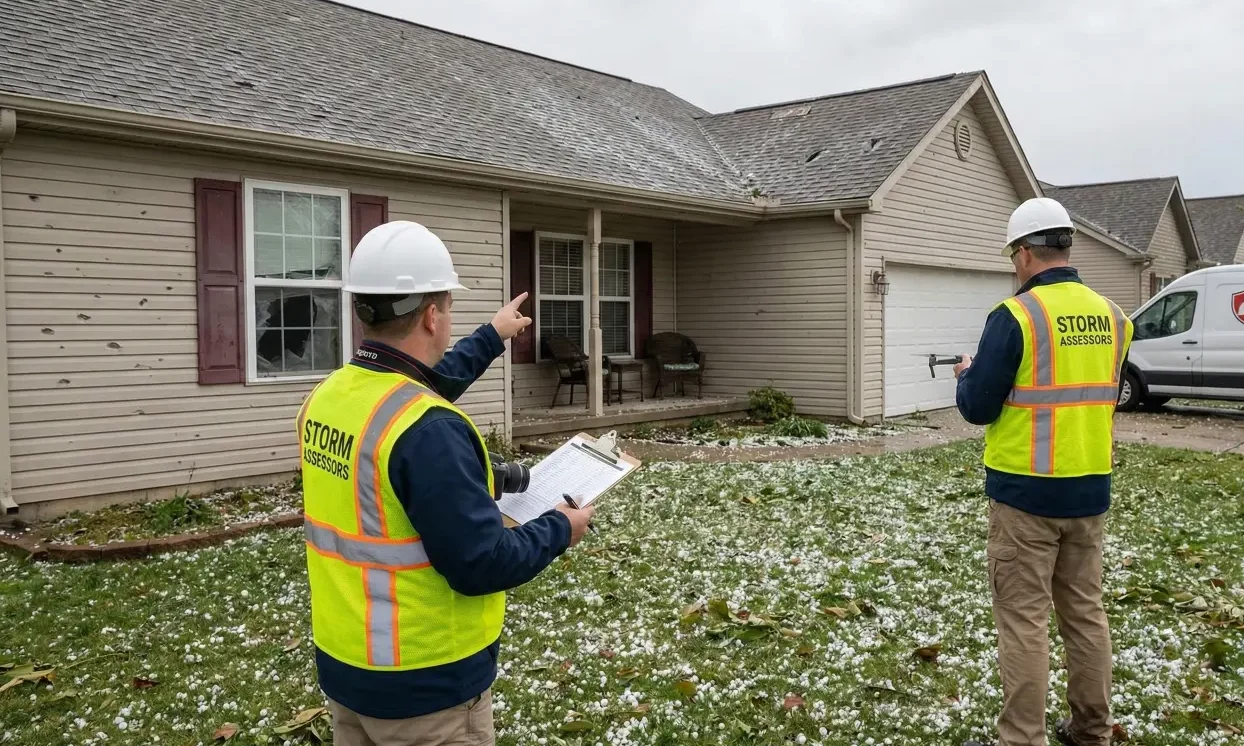
After a hailstorm, it’s rarely only the roof that takes hits—but it’s also easy to chase every nick and end up overwhelmed (or sold a “full exterior replacement” pitch you don’t trust). If you’re already seeing roof damage and dents on gutters or siding, you need a simple checklist and a clean decision rule: what to inspect, what to document, and when it’s worth involving additional trades or including items in the same insurance conversation.
A Full Exterior Inspection After Hail is necessary.
This is an evidence-first approach. The goal isn’t to “find everything.” The goal is to avoid the two expensive mistakes that happen after storms: missing scope that turns into future problems, or expanding scope without proof and creating delays, disputes, and decision fatigue.
The real issue after hail isn’t the roof—it’s missed scope and messy coordination
When the roof looks obviously impacted, it tends to pull all your attention upward. That makes sense—your roof is the primary water barrier, and visible damage feels urgent. But the more common operational problem after hail is what happens around the roof: gutters get dinged, siding gets peppered, window screens look torn, trim paint chips, and suddenly you have multiple “maybe” issues.
That’s where homeowners get stuck. Not because they don’t care, but because they’re trying to solve three problems at once:
- Figure out what is purely cosmetic versus what can affect water handling or sealing.
- Document what they’re seeing in a way that won’t have to be re-done later.
- Avoid running five separate appointments, five separate stories, and five separate opinions that don’t line up.
Why visible roof damage is a signal to expand your look, not expand your assumptions
Seeing roof damage plus dings on gutters or siding is a signal to widen the inspection lens—not to assume your entire exterior “needs replacement.” Hail often leaves a mix of impacts: some that matter, some that don’t, and some that only matter if they appear as a pattern.
The best move is to do a quick, structured exterior pass first. That way, when you do call a professional, you’re not guessing. You’re showing what you noticed, where it is, and what your real question is: “Is this just cosmetic, or is there a functional risk I should address now?”
Start with a 15-minute exterior checklist (what to check before you call anyone)
You don’t need ladders or tools for this. You’re not trying to diagnose. You’re trying to spot and document potential problem areas so a professional can confirm what’s relevant.
Pick one side of the home and walk it clockwise. Use your phone camera. If you can, do this in daylight and after any loose debris is cleared from walkways.
Gutters and downspouts
Focus on what affects water movement and attachment, not just dents.
Look for:
- Dents concentrated near edges, seams, corners, and end caps. A dent in a flat section can be cosmetic; damage near joints and edges is more likely to affect fit or water flow.
- Separated seams or gaps at corners, end caps, and downspout connections.
- Loose fasteners or hangers (gutter sagging, pulling away from fascia, or “wavy” lines when you look down the length).
- Downspout dents or kinks that look like they could restrict flow, especially near elbows.
- Signs of overflow you can see from the ground: streaking on siding, splash marks near the foundation, or soil erosion under a downspout outlet.
Decision rule (homeowner-level):
- If gutters are dented but still straight, securely attached, and draining normally, that may be cosmetic.
- If you see separation, sagging, attachment issues, or evidence of overflow, it’s worth escalating as a functional concern.
Siding and trim
Siding damage is easy to underestimate because the wall still “looks fine.” You’re looking for breaks in continuity—places where water could get behind siding or where panels have loosened.
Look for:
- Cracks, chips, or punctures (especially near edges and seams).
- Loose edges or lifted panels—areas where a panel looks bowed or has shifted.
- Impact clusters (lots of small hits in one zone) rather than a few isolated marks.
- Damaged trim, fascia, and soffit—hail can scuff coatings and dent softer materials.
- Paint chipping or exposed substrate on trim pieces, which can be a durability issue over time even if it isn’t an “emergency.”
Decision rule:
- Isolated scuffs may be cosmetic.
- Cracks, loosened edges, missing pieces, or clustered impacts should be evaluated—those are the situations more likely to create long-term water entry risk.
Windows and exterior openings
Most homeowners focus on glass. But hail-related issues are often about the surrounding components: screens, frames, and seals.
Look for:
- Torn or dented window screens, especially on the storm-facing side.
- Dings in frames (metal frames can show impacts).
- Damaged sealant/caulk lines around windows and doors—look for obvious gaps or separations.
- Trim dents and paint chips around openings.
- Garage doors and exterior vents—not because they “must be replaced,” but because they’re common impact zones worth documenting.
Decision rule:
- If you only see screen damage, that may be a targeted repair.
- If you see frame impacts, trim separation, or obvious gaps in seals, it’s worth having a specialist confirm whether function or weather-tightness is affected.
Soft metals and roof accessories you can observe safely from ground level
From the ground, you can often spot impacts on softer components that show hail signatures clearly. You’re not climbing the roof—you’re looking for visible clues.
Look for:
- Roof vents, caps, and flashing edges you can see from a safe vantage point.
- Metal drip edge and other visible metal trims that may show dents.
- Outdoor HVAC covers, metal mailboxes, and light fixtures—these aren’t necessarily claim items, but they can help establish hail direction and intensity patterns.
Documentation basics: wide shots → mid shots → close-ups, consistent angles
This is where most homeowners lose time later. They take close-ups that don’t show where the damage is, or they take wide shots that don’t show what the damage is.
A simple photo order prevents that:
- Wide shot: show the entire side of the home (so orientation is obvious).
- Mid shot: show the specific area (e.g., the gutter run above a window).
- Close-up: capture the damage detail (dents, cracks, separation).
- Repeat with consistent angles so comparisons are fair.
Also:
- Note the date you took photos and the side of the house (front, back, left, right).
- If you can, take a short video walkaround narrating what you’re seeing. Keep it simple: “Front right gutter has dents near the corner; siding has clustered marks near the downspout.”
Use the phrase once, naturally: If you’re unsure, this is exactly when a full exterior inspection after hail becomes useful—not because everything will be replaced, but because you need a defensible evaluation of what matters.
The “pattern test”: when dents are cosmetic vs. when they suggest functional risk
Hail damage can be confusing because many impacts are small. The pattern test helps you stop treating every mark as equal.
The basic idea:
- Isolated hits are more likely to be cosmetic.
- Clusters and alignment can indicate exposure severity and increase the chance that something is functionally compromised.
This is not a guarantee. It’s a way to prioritize where you spend attention.
Clustered impacts vs. isolated hits (what patterns can imply)
Patterns that tend to matter more:
- Clusters on one storm-facing elevation (the side that took the wind-driven hail). That can explain why damage appears on gutters and siding on one side, even if other sides look untouched.
- Repeated impacts along edges and joints (gutter seams, siding edges, trim corners). Joints are where small deformation can create gaps or loosen attachments.
- Impacts concentrated at a consistent height (e.g., a band across siding). That can help a pro assess exposure and whether the marks are consistent with hail rather than unrelated wear.
Patterns that are often lower priority:
- A few scattered dents on flat gutter faces with no sagging or separation.
- Light scuffing on trim paint without cracking or gaps.
- Minor screen dents that don’t affect operation.
Water-handling components: why gutters and downspouts get prioritized
Gutters are a force multiplier in exterior problems. When they fail, water goes where it shouldn’t—behind siding edges, onto fascia, against foundations, and into landscaping that wasn’t designed to handle constant runoff.
That’s why many pros prioritize gutters and downspouts in post-storm evaluations:
- They’re visible.
- They show impact patterns clearly.
- They directly affect drainage.
If you only have bandwidth to document one “beyond the roof” category first, start there.
The misconception reversal: “If it’s dented, it must be replaced” (not always)
After a storm, two narratives show up quickly:
- “It’s dented, so it’s ruined.”
- “It still works, so it doesn’t matter.”
Both can be wrong.
A dent can be purely cosmetic—especially on soft metals. But dents near joints, dents that accompany separation, or dents that change alignment can signal functional problems. The same is true for siding: peppered marks might be cosmetic, but cracks, loosened edges, and gaps are a different class of issue.
The more grounded way to think about it is this:
- Cosmetic: the surface looks impacted, but the component still performs its job and remains properly sealed/attached.
- Performance-related: the impact changes drainage, attachment, alignment, or sealing.
Where homeowners commonly overreach:
- Assuming every dent becomes an insurance scope item.
- Letting a contractor jump from “hail happened” to “replace everything” without showing why each component is functionally compromised.
Where homeowners commonly underreact:
- Ignoring attachment issues on gutters because “it’s only a dent.”
- Ignoring siding separation because “the wall isn’t leaking.”
- Skipping documentation because “I’ll remember where it was” and later realizing they can’t.
If you’re in the exact scenario trigger—roof damage plus dings on gutters and siding—your best move is to ask for the why behind any recommendation. A responsible opinion should be able to show you what’s cosmetic, what’s functional, and what evidence supports each.
Claim and inspection timing: how to keep options open without creating chaos
Storm events compress time. Neighbors are scheduling inspections. Contractors are busy. Homeowners feel pressure to move fast, but fast doesn’t have to mean scattered.
The goal is to keep your documentation coherent and your decision path simple.
One documentation set, not five separate stories
The cleanest approach is to treat your exterior as one system with multiple components:
- Roof
- Gutters/downspouts
- Siding/trim
- Windows/screens/openings
That doesn’t mean one contractor does everything. It means your documentation and observations stay unified.
Practical steps:
- Keep all photos/videos in one folder labeled with the storm date (or approximate date).
- Use a short notes doc: “Front elevation: gutter corner dented; siding marks near downspout; screen dented on right window.”
- When someone inspects, ask them to reference your notes and add theirs. This reduces contradictory “stories.”
What to do if multiple contractors give conflicting opinions (how to request evidence)
Conflicting opinions are common because different trades focus on different outcomes. The solution isn’t to pick the loudest voice—it’s to ask for clear evidence.
If you get conflicting recommendations, ask each party:
- “Can you show me photos of what you’re concerned about?”
- “Is the issue cosmetic, or does it affect function (drainage, sealing, attachment)?”
- “What specifically would you expect to happen if we do nothing for 6–12 months?”
- “What would change your mind? What evidence would confirm or rule this out?”
A credible recommendation doesn’t rely on urgency. It relies on clarity.
Do you need separate contractors for storm damage? A simple coordination map
Not always. But sometimes, yes—and the reason isn’t “more sales.” It’s specialization.
Here’s a simple way to think about it.
Roof inspection/documentation lead (what that role typically covers)
A roof-focused inspection/documentation lead typically:
- Evaluates roof surfaces and visible storm impacts
- Documents findings with photos/video
- Helps translate findings into a clear scope discussion
- Flags related exterior concerns that are visible and relevant (like obvious gutter attachment problems)
They are often the best first call when the roof is clearly impacted, because the roof tends to be the primary decision driver.
When to involve a siding specialist or window specialist (TBD thresholds; evidence-led)
You may consider involving a specialist when:
- You see cracks, loosened edges, or missing pieces in siding/trim (not just dings).
- There are gaps or separation at windows/doors, or frame impacts that might affect fit.
- Screen damage is widespread enough that it becomes a system issue rather than a one-off fix.
Exact thresholds depend on materials and conditions (TBD), so stay evidence-led: document what you see, then ask the right specialist to confirm what’s cosmetic versus functional.
How to avoid duplicated inspections and “scope gaps”
Duplication happens when each contractor starts from scratch. Scope gaps happen when each contractor assumes the other is covering it.
A simple coordination approach:
- Start with one lead inspection (often roof + visible exterior observations).
- Share your photo folder and notes with anyone else involved.
- Ask each trade to define their scope in plain language: “I’m evaluating siding panels and trim for cracks, separation, and attachment issues.”
This keeps everyone aligned and reduces the “he said / she said” cycle.
Mistakes that get homeowners stuck (and how to avoid them)
Storm decisions feel urgent, but the biggest problems come from avoidable process mistakes.
Starting repairs before documentation is complete
Emergency mitigation is one thing. But if you start replacing components before you’ve documented what happened, you can lose the ability to have a clean, evidence-based conversation later.
Safer approach:
- Document first whenever possible.
- If something truly requires immediate action (like active water intrusion), take photos before and after any temporary mitigation and keep receipts/records.
Mixing upgrades with storm scope without clarity
It’s normal to think, “If we’re doing this, maybe we should upgrade.” The risk is blending “storm-related scope” with “elective upgrades” until no one can tell what’s what.
Safer approach:
- Keep two lists: “storm-related concerns to evaluate” and “nice-to-have upgrades.”
- Make decisions in that order. It reduces confusion.
Letting urgency replace evidence
Neighbors can create a rush dynamic: “Everyone’s filing” or “You have to sign today.” That pressure leads to decisions you can’t defend later.
Safer approach:
- Use your checklist and documentation set as your anchor.
- Choose contractors who explain and document, not just sell.
Next steps: the low-friction path to a defensible exterior plan
If you’re standing in your driveway right now looking at roof damage and dings on gutters or siding, here’s a straightforward path forward.
What to prepare before the inspection appointment (photos, dates, notes)
Bring:
- Your photo folder (wide/mid/close-up sets)
- A short note list by elevation (front/back/left/right)
- The approximate storm date and any immediate observations (e.g., “noticed denting on gutters the next morning”)
- Questions you want answered:
- “What is cosmetic vs functional?”
- “What should be monitored vs addressed now?”
- “If we need other trades, which ones and why?”
What “good” looks like: photo/video documentation + clear scope rationale
A good output from an inspection is not just “you need X.” It’s:
- Photos/videos that show what was found
- A plain-language explanation of why each item matters (or doesn’t)
- A clear next step that matches your situation and reduces coordination friction
If your goal is to keep decisions defensible, this is also where a full exterior inspection after hail can make sense: one coherent assessment that helps you avoid missing scope or creating chaos.
Schedule a documentation-led inspection
Seeing roof damage and dents on gutters or siding can put you in a tough spot: act too small and miss scope, act too big and waste time.
Book a free inspection so you can get photo/video documentation and a clear, evidence-based next step.
We’ll help you understand what’s roof-related, what’s exterior-related, and what you should verify next—without the guesswork.
Get the facts, not a guess.
FAQ content
- Should I have siding inspected after hail if my roof is clearly damaged?
Yes—at least a documented look is worth it if you’re already seeing dings or marks on siding or trim. You’re not assuming replacement; you’re confirming whether damage is cosmetic or whether there are cracks, loosened edges, or gaps that could create longer-term water issues. - What gutter damage matters after hail—dents, seams, or drainage issues?
Drainage and attachment issues matter most. Dents can be cosmetic, but dents near seams, corners, and end caps—or sagging, separation, loose hangers, or signs of overflow—are worth escalating for professional evaluation. - When should windows be included in a storm damage claim?
Consider windows and openings when you see screen damage, frame impacts, or obvious gaps in sealant/trim. Document what you see first, then ask the appropriate specialist to confirm whether function or weather-tightness is affected. - Do I need separate contractors for roof, siding, and window storm damage?
Not always. Often a roof inspection/documentation lead can flag what’s worth a closer look, and then a siding or window specialist can evaluate specific concerns. The key is sharing one documentation set so you don’t get five disconnected opinions. - What photos should I take before scheduling a storm inspection?
Use wide shots (entire elevation), mid shots (area on that elevation), and close-ups (damage detail). Keep angles consistent, label the side of the house, and take a short video walkaround narrating what you’re seeing. - What are common mistakes homeowners make when documenting hail damage?
The big ones are taking only close-ups with no context, not labeling where damage is located, starting non-emergency repairs before documenting, and letting urgency pressure override evidence-based decisions.
Seeing roof damage and dents on gutters or siding can put you in a tough spot: act too small and miss scope, act too big and waste time.
Book a free inspection so you can get photo/video documentation and a clear, evidence-based next step.
We’ll help you understand what’s roof-related, what’s exterior-related, and what you should verify next—without the guesswork.
Get the facts, not a guess.
RELATED LINKS: