A contractor mentions “bad decking” or “attic ventilation” and suddenly your roof quote feels less simple than you expected. That’s because shingles are only the visible layer; a roof system can look brand-new and still fail early if moisture, heat, or weak decking is ignored. If you’re googling after hearing those terms, you’re in the right place—this is the part of roof replacement that separates a clean-looking install from a truly durable roof.
This guide breaks the roof system down in plain English, shows what can go wrong quietly, and gives you specific questions and proof requests so you can make a roofer show you what they’re fixing—before you sign.
Learn how roof ventilation and decking problems can shorten roof life—and what to ask your roofer for proof.
A “new roof” is more than shingles—and the hidden parts fail quietly
Most homeowners shop a roof the way they shop a visible product: shingle brand, color, warranty language, maybe upgrade options. That’s normal. But a roof isn’t one product—it’s a system. And the system tends to fail in the places you can’t see from the driveway.
The roof system layers in plain English (shingles, underlayment, decking, ventilation)
Think of a roof like a layered barrier with a structural base and an airflow plan:
- Shingles: the outer “shell” that sheds water and takes sun and weather.
- Underlayment: the protective layer beneath shingles that adds backup water resistance.
- Decking: the wood base the roof is built on. Shingles are fastened through the layers into the decking. If the decking is weak, the roof can’t hold fasteners and seal the way it should.
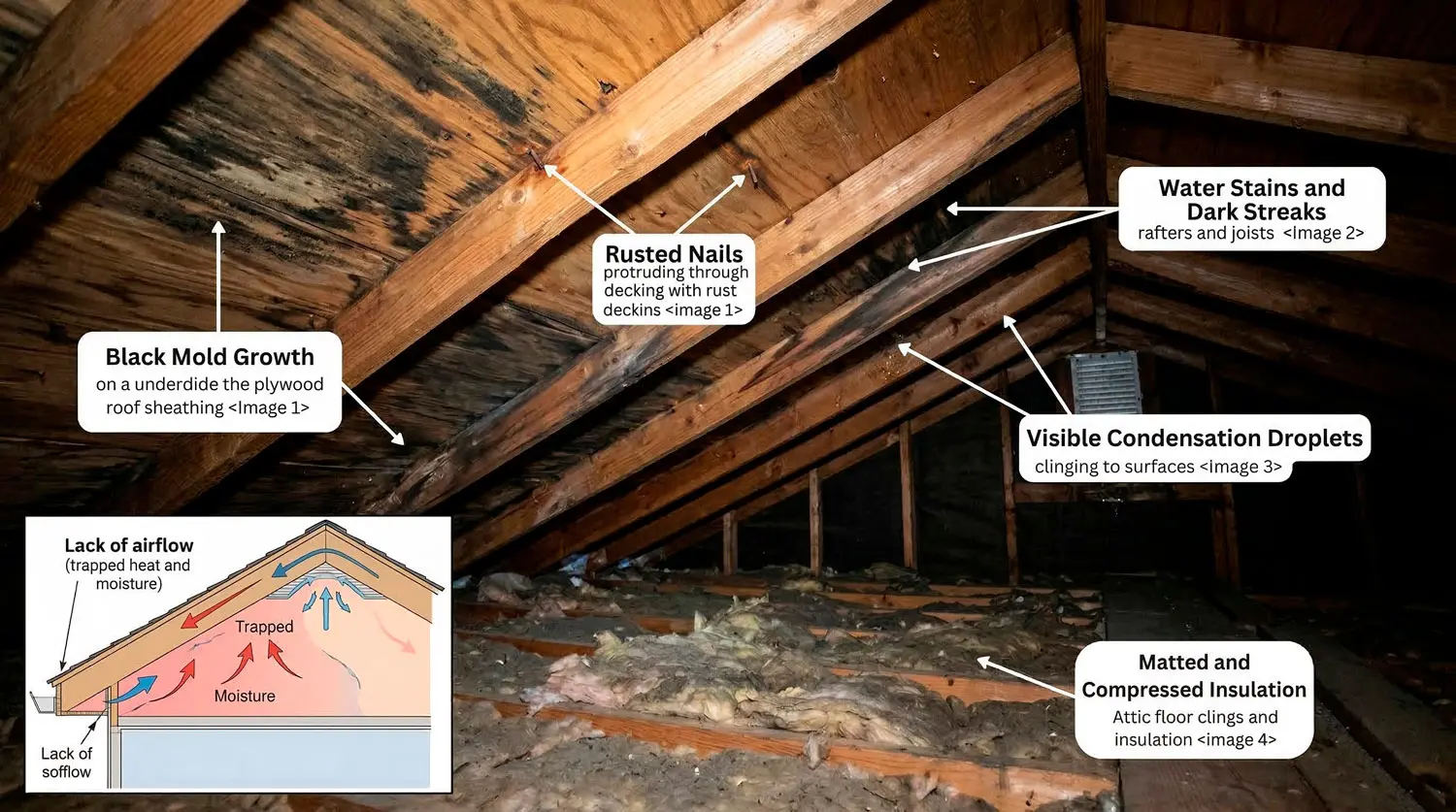
- Ventilation: the airflow strategy for your attic. It’s not about comfort alone. It helps manage heat and moisture so your attic and roof structure don’t become a slow-cooking, moisture-trapping environment.
If any of these layers is compromised—or if the system is built without a real ventilation plan—you can end up with a roof that looks fine in photos but performs poorly behind the scenes.
Why problems underneath don’t show up on day one
This is what makes ventilation and decking issues so frustrating: they don’t always cause immediate, dramatic failure. Instead, they show up as gradual or intermittent issues:
- Subtle attic moisture that becomes musty odor or staining over time
- Heat buildup that stresses materials season after season
- A weak substrate that holds “just fine” until wind, time, or temperature swings expose the weakness
That’s why you can hear “your roof looks good” while still dealing with problems. “Looks good” is not the same as “built on a solid base with a balanced airflow plan.”
The two silent roof-killers: trapped moisture/heat and weak decking
If you want your roof to last and avoid premature failure, these are the two categories to care about more than almost any upgrade: ventilation and decking.
What ventilation is supposed to do (air in + air out)
Ventilation is easiest to understand as a simple concept: air in + air out.
- Intake is how fresh air enters (often through the lower portions of the roof/attic boundary).
- Exhaust is how warm, moist air exits (often through higher points).
The big idea is balance. A ventilation “upgrade” that only adds exhaust without considering intake may not perform the way you expect. In some situations, it can even pull air from places you don’t want (like living space) because the attic is trying to make up the difference.
You don’t need to memorize vent types to have an intelligent conversation. You just need to insist on this: What’s the intake? What’s the exhaust? Where is each one located, and why does this plan fit my roof?
What decking does (and why “good shingles” can’t compensate)
Decking is the roof’s structural base. Shingles aren’t simply “laid” on a roof—they’re fastened and sealed as part of a system. If the decking is soft, warped, delaminated, or otherwise compromised, the roof may not fasten or lay correctly, even if the shingles are top-tier.
Here’s the key mindset shift: You can’t buy your way out of a bad substrate.
A great shingle on weak decking is like installing premium flooring over a damaged subfloor. It may look finished—but the base will eventually show its flaws.
Symptoms homeowners notice first (and what they can actually mean)
Many homeowners first suspect “ventilation” or “decking” because something feels off, not because they can see a clear problem. The trick is to treat symptoms as clues and then require evidence.
Attic heat, musty smells, staining, uneven shingles (safe, non-technical framing)
Common “something’s not right” signals include:
- Attic feels extremely hot compared to the rest of the house
- Musty odor or a damp smell that comes and goes
- Staining on attic wood surfaces or insulation
- Bathroom fan exhaust that seems to linger or worsen attic odor
- Uneven-looking rooflines or shingles that appear wavy or inconsistent
- Recurring minor leaks around penetrations or after certain storms
None of these symptoms automatically proves a single cause. But they justify deeper questions—especially if you’re about to replace the roof and want to avoid locking in hidden issues.
When symptoms point to ventilation vs when they point to decking
Use a simple “most likely” lens (not a diagnosis):
- Ventilation issues often show up as comfort or moisture patterns: heat buildup, condensation-type signs, musty smells, seasonal patterns.
- Decking issues often show up as structure and surface behavior: sagging, wavy planes, soft spots (usually discovered during tear-off), fastener holding concerns, or recurring problems that don’t improve after “surface fixes.”
The point isn’t to decide the answer yourself. The point is to know what evidence to ask for so you don’t accept vague explanations.
Ventilation problems: what “bad” looks like without getting overly technical
A lot of homeowners are told “you need more vents” without a real plan. That’s where quiet failures begin: changes that sound sensible but aren’t tied to a system design.
Intake vs exhaust: why adding vents can make things worse if unbalanced
If you only remember one line from this article, let it be this: ventilation needs a path.
Air should be able to enter and exit without shortcuts. When a plan is unbalanced, you can get outcomes like:
- New exhaust vents that don’t move much air because there isn’t enough intake
- Air being pulled from unintended areas because the attic is “hungry” for intake
- Homeowners paying for additional vents and still feeling like “nothing changed”
You don’t have to argue with a roofer about the perfect design. You can simply require clarity:
“Explain where air enters and where it exits, and why this creates a balanced system for my roof.”
Red flags in proposals: vague “add vents” language with no plan
Watch for proposal language that sounds helpful but lacks specifics:
- “Add ventilation” with no mention of intake vs exhaust
- “Install ridge vent” without discussing how the rest of the system supports it
- “Add box vents” without explaining placement and why they’re needed
- No mention of whether existing ventilation is being changed, removed, or rebalanced
If the scope doesn’t describe the system logic, you’re not buying a plan—you’re buying parts.
A better proposal may include:
- What will be installed, where, and why
- What will be removed or modified (if anything)
- What the contractor observed that led to the recommendation
- Photo documentation of existing conditions (when possible)
Decking problems: how bad decking ruins the install even if the roof looks fine
Decking is where many homeowners get trapped: “We can’t know until we tear off.” That may be partly true, but you can still protect yourself with pricing clarity and documentation requirements.
What roofers mean by “soft,” “delaminated,” or “damaged” decking (TBD: wording)
Roofers often use quick terms to describe what they’re seeing. While exact wording varies, these generally point to the same idea: the wood base is not strong and stable enough to build on.
- “Soft” often implies the wood has lost integrity and may not hold fasteners well.
- “Delaminated” often refers to layered wood separating—common in some plywood conditions.
- “Damaged” can include moisture impact, rot, warping, or other integrity issues.
You don’t need to diagnose the cause. You need to require proof of condition and clarity on what gets replaced.
The change-order trap: how to require documentation before replacement
Here’s a common scenario:
You get a roof quote. It includes little or no decking. On install day, after tear-off, the contractor says, “Your decking is bad—this will cost extra,” and you feel cornered.
Sometimes decking replacement is legitimate. Sometimes it’s inflated. The only way to know is documentation and transparent pricing.
Protect yourself before you sign by asking for:
- Decking pricing structure in writing
- How decking replacement is priced (per sheet, per area, or other method)
- What triggers replacement (how they decide it needs to be replaced)
- A documentation requirement for any decking replacement
- Photos or video showing the affected areas (when feasible)
- Clear notes or marked locations so you understand what was replaced
- A count of replacement units consistent with the price method
- A communication step before proceeding
- “If decking replacement is needed beyond X, you will show me and confirm cost before continuing.”
This isn’t about distrust. It’s about keeping your decision-making power when the roof is already open.
The misconception to avoid: “If the shingle brand is good, the roof will last”
This is the most expensive misunderstanding in roofing: shopping the roof like a product, not a system.
Why installation conditions matter as much as product selection
A roof can fail early even with a high-quality shingle if:
- The base (decking) doesn’t provide a stable, secure fastening surface
- Moisture and heat aren’t managed properly over time
- Details around penetrations and transitions aren’t executed well
- The scope ignores underlying conditions discovered during inspection or tear-off
That’s why the “best shingle” question is usually less important than:
- “What are you building this on?”
- “How are you managing heat and moisture?”
- “How will you prove what you replaced?”
How to think like a quality inspector, not a shopper
You don’t need to become a roofing expert. You just need to shift your buying posture:
- Don’t just ask what they’re installing. Ask why it’s appropriate for your roof.
- Don’t just accept “we’ll see.” Ask how you’ll be shown if something changes.
- Don’t just compare totals. Compare scope clarity and proof commitments.
A shopper chooses products. A quality inspector chooses processes and verification.
Questions to ask your roofer before you sign (copy/paste list)
Use these questions exactly as written if helpful. You’re not trying to “catch” a contractor—you’re trying to confirm they have a real plan.
Ventilation plan questions (what’s in, what’s out, where, why)
- “What is the intake in your ventilation plan, and where is it located?”
- “What is the exhaust in your plan, and where is it located?”
- “What’s your reasoning for this plan for my roof specifically?”
- “Are you changing existing ventilation, or adding to it?”
- “If you’re adding vents, what problem are you solving—and how will we know it’s addressed?”
- “Can you show me (with photos if possible) what you’re seeing that led to the recommendation?”
If the answers are vague, ask the clarifying version:
- “Can you explain the airflow path in plain English—air in from where, and out through what?”
Decking verification questions (how they’ll show you, how it’s priced)
- “How do you decide decking needs replacement?”
- “How is decking replacement priced in your quote?”
- “What’s included in the base quote vs what becomes an extra?”
- “If you find bad decking during tear-off, how will you show me and confirm the cost before proceeding?”
- “Will you document replaced decking with photos/video and a count of replaced sections?”
A strong contractor won’t be offended by this. They’ll be glad you care about doing it right.
Documentation questions (photos/video, marked-up scope, onsite PM)
- “Will I receive photo/video documentation of key conditions and repairs?”
- “Can you provide a marked-up scope that clearly lists ventilation items and any potential decking allowance?”
- “Who is responsible on-site for quality checks and communication?”
- “At the end of the job, what do you review with the homeowner before final payment?”
These questions matter because they turn “trust me” into “show me.”
Proof you should request during and after the job
The goal is simple: if you pay for ventilation and decking work, you should be able to see evidence that it happened.
Photo set checklist: decking condition, replaced sections, ventilation components
Ask for a basic photo set. It doesn’t need to be fancy—just clear and labeled.
Minimum useful set:
- Photos of existing attic/roof conditions observed during inspection (where feasible)
- Photos of decking condition during tear-off (especially any “bad” areas)
- Photos of replaced decking sections before underlayment goes on (where feasible)
- Photos of ventilation components installed (key areas, not necessarily every detail)
- Photos of completed rooflines around penetrations and transitions (to document finish quality)
If a contractor offers photo/video documentation as part of their process, it’s a strong trust signal—especially for homeowners who don’t want surprises.
Final walk-through: what to confirm before final payment (cleanup + attic check)
Before final payment, confirm the basics:
- The scope items you agreed to are completed (especially ventilation items)
- Any decking replacement beyond the base scope was documented and approved
- Cleanup expectations are met (especially nails/debris near driveways and walkways)
- If attic access is easy and safe, do a quick check for obvious disturbance (without trying to “inspect” like a pro)
You’re not looking for perfection. You’re looking for alignment between what was promised and what was delivered.
Low-friction next step: schedule a documentation-led inspection that includes decking + ventilation
If you’re hearing “decking” and “ventilation” in quotes and you’re not sure what’s real, don’t guess. A documentation-led inspection is designed for exactly this moment: turning vague concerns into visible evidence and a clear plan.
What a real inspection covers beyond shingles
A thorough inspection may look at more than the surface—often including:
- Shingle condition and storm/age-related wear indicators
- Flashing and penetration areas that commonly drive leaks
- Signs that point toward decking concerns (without making assumptions)
- Ventilation components and how the system is functioning as a whole
The point is not to overwhelm you with technical details. It’s to give you clarity on what matters, what’s optional, and what needs proof before any change orders happen.
Book a free roof inspection with photo/video documentation
If you’re hearing ‘decking’ and ‘ventilation’ in quotes and you’re not sure what’s real, don’t guess.
Schedule a free roof inspection and get photo/video documentation of what’s happening—shingles, flashing, decking indicators, and ventilation.
We’ll explain what matters, what’s optional, and what needs proof before you approve any change orders.
Book your inspection and get the facts, not a guess.
FAQ content
1) What are signs of poor roof ventilation in the attic?
Common signals can include excessive attic heat, musty odors, and moisture-related staining or dampness patterns. These signs don’t prove a single cause on their own, but they’re a reason to ask for an explained intake-and-exhaust plan rather than a vague “add vents” recommendation.
2) Can bad decking ruin a new roof?
It can. Decking is the structural base that the roof system fastens into. If the base is weak or damaged, the roof may not fasten and seal as intended, even if the shingles are high quality.
3) How do roofers determine if decking needs replacement?
Some issues may be visible during inspection, but many are confirmed during tear-off when the decking is exposed. The important part is process: ask what criteria they use and how replacement is priced and documented before work proceeds.
4) How can I verify my roofer replaced damaged decking?
Ask for photo/video documentation of the affected areas during tear-off, photos of replaced sections before underlayment is installed, and a clear count consistent with how replacement is priced. Also ask for a marked scope note showing where replacement occurred.
5) Can ventilation issues cause roof warranty problems?
Some warranties and installation requirements may depend on ventilation and substrate conditions. Ask your roofer to cite the specific product requirements that apply to your roof and ensure the scope reflects those requirements.
6) What should a ventilation plan include in a roof replacement quote?
At minimum, it should describe the intake and exhaust components, where they’ll be located, and why that plan fits your roof. Proposals that simply say “add vents” without explaining the airflow path are worth clarifying before you sign.
If you’re hearing ‘decking’ and ‘ventilation’ in quotes and you’re not sure what’s real, don’t guess.
Schedule a free roof inspection and get photo/video documentation of what’s happening—shingles, flashing, decking indicators, and ventilation.
We’ll explain what matters, what’s optional, and what needs proof before you approve any change orders.
Book your inspection and get the facts, not a guess.
RELATED LINK: