
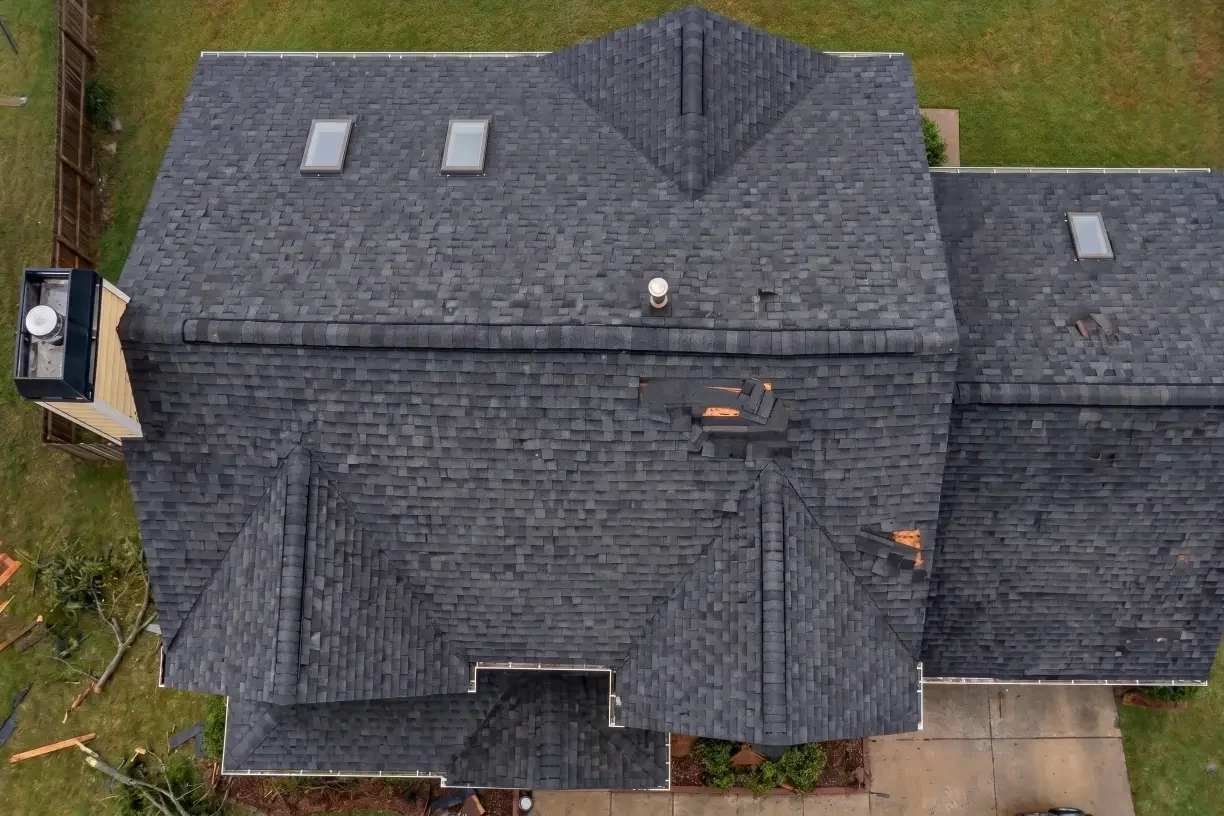
The storm has passed, and now the neighborhood is buzzing.
One neighbor is talking about meeting an adjuster. Another says three roofers knocked on their door before lunch. Someone down the street is already saying they’re getting a whole new roof. Meanwhile, you’re standing in your driveway looking up at your own house and thinking: I see a few small marks, maybe some rough-looking shingles, but nothing dramatic.
Is my roof really damaged after hail?
That uncertainty is normal.
After a storm, homeowners often feel pulled in two directions at once. On one side, there’s pressure to act fast because everyone else seems to be doing something. On the other, there’s hesitation because your roof doesn’t obviously look ruined. The real job in that moment is not to copy the loudest reaction. It’s to separate minor wear, possible cosmetic storm effects, and signs of real functional damage that may deserve a closer look.
This article is meant to help with exactly that.
Why This Feels So Confusing After a Storm
A storm creates a strange kind of urgency. Even if your home looks mostly fine, the activity around you can make it feel like you must be missing something.
That’s especially true after hail or high wind. Roof damage is not always as visible as a broken window or a fallen tree limb. You may see only a few dents on a vent, a patch of rough-looking shingles, or some granules in a gutter. Or you may not see much from the ground at all.
At the same time, contractors may be moving through the area quickly, and neighbors may be swapping opinions that sound definitive. One person says, “If the street got hit, your roof got hit.” Another says, “If it’s not leaking, you’re fine.” Neither shortcut is especially reliable.
Claim activity around you is not proof of your own roof condition.
Two houses on the same street can respond differently to the same storm. Roof age, shingle type, installation quality, slope direction, tree coverage, and pre-existing wear can all affect what a storm does—or appears to do. That’s why the first useful step is not assuming your roof is either definitely damaged or definitely fine. It’s slowing down enough to assess what changed, what you can reasonably observe, and where the limits of those observations begin.
Start Here: What You Can Notice From the Ground
There are a few safe, realistic things a homeowner can notice without getting on the roof.
You may be able to see obvious missing shingles, lifted tabs, bent metal, fallen debris, or fresh pieces of roofing material on the ground. You may notice granules in downspouts or gutters. You may also spot dents on softer metal components like vents, gutters, flashing edges, or downspouts. Inside the home, you may notice new stains, damp areas, or changes in the attic after heavy rain.
Those observations matter. They give you a starting point.
But they also have limits.
Reading hail damage from the ground is difficult for one simple reason: many important roof changes are subtle. A roof can look mostly normal from the driveway and still have issues that are easier to evaluate up close. A few small marks visible from the yard may also tell you less than you think. Some marks are storm-related. Some are ordinary wear. Some are just surface-level imperfections that do not tell the whole story either way.
That’s why “I don’t see much” does not always mean “nothing happened.”
It also works in reverse. Seeing a few rough spots does not automatically mean you have meaningful storm damage.
Ground-level observations are helpful, but they are not the final answer. They are best treated as clues. They can tell you whether something changed, whether anything looks obviously off, and whether the roof deserves a closer, documented look. They are not a substitute for inspection when the situation is unclear.
Minor Wear or Real Damage? The First Triage Questions to Ask
Before you jump to conclusions, ask a few basic triage questions.
What changed after the storm?
Start with timing.
If the roof looked one way before the storm and different afterward, that change matters. Maybe you noticed fresh granules collecting in a gutter. Maybe a shingle edge now looks slightly lifted. Maybe a metal vent cap has new dents. Maybe a room that never had any staining now shows a faint water mark after heavy rain.
A recent change does not automatically mean serious storm damage, but it is more useful than a vague feeling that the roof “looks old.”
Is the issue isolated, patterned, or widespread?
Try to think beyond a single mark.
One random blemish may mean very little. A repeated pattern of similar impacts or changes across multiple slopes, metal components, or vulnerable areas may suggest a broader event. On the other hand, a roof with patchy aging, isolated wear, and one or two questionable spots may point to a different story.
This is one reason homeowners get stuck. It is hard to tell from the ground whether what you’re seeing is isolated or part of a larger pattern.
Has anything functional changed inside or around the home?
Not every roofing issue begins with an interior leak, but functional changes still matter.
Ask yourself whether anything else happened after the storm:
- Did you notice moisture where there wasn’t any before?
- Did a shingle tab look lifted or out of line?
- Are there new signs around flashing, vents, or valleys?
- Did anything about the roof system start behaving differently, even if subtly?
These questions help shift the conversation from panic to triage. The goal is not to diagnose everything from the driveway. It’s to decide whether what you’re seeing feels more like normal aging, uncertain cosmetic change, or something worth documenting more carefully.
The Signs That Often Get Mixed Up
This is where early research often goes sideways. Homeowners see online photos, hear roofing terms, and end up comparing things that are not actually the same.
Granule Loss vs Bruising
Granule loss is one of the most misunderstood signs on an asphalt shingle roof.
Granules are the textured outer surface on the shingle. Over time, roofs can naturally lose some granules due to age, weather exposure, and normal wear. So if you notice granules in the gutter or a rough-looking patch on a shingle, that does not automatically tell you the roof has hail damage.
Bruising is different. In homeowner terms, bruising refers to a softer-looking or compromised area on the shingle that may suggest impact rather than simple aging. The problem is that not all rough-looking spots are bruises, and not all surface irregularities mean the same thing.
That’s why this distinction matters: a roof can show granule changes without showing the type of storm-related impact people assume they’re seeing. Not all rough-looking shingle changes point to the same type of issue.
Hail Marks vs Normal Roof Aging
Older roofs can create a lot of false alarms.
Blistering, weathering, surface wear, discoloration, and brittleness can all make a roof look damaged to an untrained eye. After a storm, it becomes easy to look at those existing conditions and reinterpret them as new hail damage simply because you’re paying closer attention now.
At the same time, some storm-related effects may blend into an already aging roof and become harder to identify casually.
This is why “hail damage vs normal roof aging” is such a common point of confusion. The difference is not always visible in one dramatic spot. It often comes down to pattern, context, and whether the visible condition appears consistent with storm impact, long-term wear, or both.
Cosmetic Shingle Changes vs Functional Damage
This is one of the most important distinctions in the whole conversation.
Some storm-related roof changes may be mostly surface-level, while others may affect how the roof performs.
In plain language, cosmetic damage is about appearance. Functional damage is about whether the roof’s ability to shed water or protect the structure may be compromised. The hard part for homeowners is that surface appearance and actual significance do not always match. A small-looking mark can still deserve attention. A visible blemish can also turn out to be mostly aesthetic.
That is why it is not helpful to make blanket assumptions in either direction.
Wind Effects That May Not Look Dramatic at First
When people think about wind damage, they often picture shingles missing all over the yard.
Sometimes that happens. Sometimes it does not.
Some wind-related issues may be easier to confirm during a closer inspection than from ground level. A shingle may be lifted, loosened, creased, or slightly displaced without creating an obvious visual emergency from the driveway. The roof may still look mostly intact while certain areas deserve a closer look.
This is one reason “no dramatic damage” should not be treated as the same thing as “no possible damage.” It is also why homeowners who only see small changes often feel stuck. The roof does not look ruined—but that alone does not answer the question.
The Contrarian Point: Small Marks Don’t Always Mean Small Problems—and Big Neighborhood Panic Doesn’t Mean You Need a Claim
This is the part that helps calm the whole situation down.
Small marks do not always mean small problems. But big neighborhood panic does not mean you need a claim, either.
Both extremes can push homeowners into bad decisions.
On one side, you have the “It’s probably nothing” mindset. That can lead people to ignore changes simply because they do not look dramatic. Sometimes that turns a manageable concern into a longer period of uncertainty.
On the other side, you have the “Everyone around me is filing, so I should too” mindset. That can lead homeowners to treat community activity like proof, even when their own roof condition is still unclear.
The more useful approach is less emotional and more grounded. Ask: what do I actually know, what looks new, what remains uncertain, and what would help verify it?
This matters because visible severity and actual significance do not always match. A quiet-looking roof may deserve attention. A noisy neighborhood may not tell you much about your own home. The answer is not to minimize or exaggerate what you see. It is to get clearer on what the signs likely mean before turning uncertainty into action.
When a Roof Inspection Is Actually Worth It
Not every homeowner needs to leap straight from “I saw a small mark” to “I need to file a claim today.”
But uncertainty itself can be a valid reason to get a roof checked.
A roof inspection is worth considering when:
- You noticed a recent change after the storm and are not sure what it means
- You see dents, granule changes, lifted-looking shingles, or rough spots that do not make sense to you
- The roof looks mostly fine from the yard, but the storm was strong enough to make you question that assumption
- Neighbors are reporting damage and you want your own house assessed based on facts, not comparisons
- You have an older roof and cannot easily tell storm effects from normal aging
- You have subtle signs inside the home, like staining or moisture concerns, even without a dramatic leak
Monitoring may be reasonable when what you’re seeing appears minor, unchanged, and unsupported by any other signs. But even then, “reasonable to monitor” is not the same as “definitely nothing is wrong.” It simply means the next step may be observation rather than urgency.
The key difference is pressure.
A good inspection at this stage should be about clarity, not commitment. You are not asking for a forced sales conclusion. You are asking for a documented look at whether the visible changes seem more like normal wear, cosmetic storm effects, or signs that deserve more attention.
If you’re seeing small marks but don’t want to jump straight into a claim, start with clarity. A documented inspection can help you understand whether you’re looking at normal wear, cosmetic storm effects, or signs that deserve closer attention. No pressure—just a clearer picture of what’s actually going on.
Common Mistakes Homeowners Make in the First Week After a Storm
One of the most common mistakes is using neighbors as the main benchmark.
It makes sense emotionally. If three nearby homes are suddenly talking about roofing claims, you naturally wonder whether your house is next. But neighbor activity is not a diagnosis. It is background noise until your own roof is actually evaluated.
Another mistake is assuming no leak means no issue.
A roof can sometimes show signs of damage before it shows up as an interior leak. Waiting only for water to appear in a ceiling may narrow your understanding too much. A leak is one kind of signal, not the only one.
Another early mistake is assuming every dent equals claim-worthy damage.
Homeowners often notice marks on gutters, downspouts, or metal accessories and immediately assume the roof itself must have serious hail damage. Those observations may be useful clues, but they are not a complete conclusion. They should prompt questions, not instant certainty.
Urgency can also replace evaluation. After a storm, people tend to think in extremes: do nothing, or do everything. But the smarter middle ground is often to document first, interpret second, and decide third.
That sequence protects you from both underreacting and overreacting.
What Good Verification Looks Like Before You Decide Anything
Good verification is not just someone saying, “Yep, looks damaged,” or “Nope, looks fine.”
It is evidence.
That may include photos, notes, close-up documentation of the areas in question, and a written explanation of what was reviewed and what was observed. It may also include a clearer distinction between what appears to be ordinary wear, what may be cosmetic storm-related change, and what seems more functionally important.
This is where homeowners often get their first real relief. Not because they get a dramatic answer, but because the uncertainty becomes more organized.
There is a big difference between reassurance, suspicion, and documented findings.
Reassurance sounds like, “I wouldn’t worry about it.” Suspicion sounds like, “That might be hail.” Documented findings sound more like, “Here’s what we saw, here’s where we saw it, and here’s what it may mean.”
That difference matters whether the answer ends up being minor wear, possible cosmetic damage, or something more meaningful.
Photos and written findings can make next-step decisions easier to understand. They give you something more stable than memory, neighbor stories, or pressure from the moment. They also make it easier to decide whether you should keep monitoring, get a second opinion, or move into a claim-related conversation with better context.
The Low-Pressure Next Step if You’re Still Not Sure
If you are still stuck between “maybe it’s nothing” and “what if I’m missing something,” that is a reasonable place to be.
It usually means you do not need more noise. You need a better look.
The low-pressure next step is not assuming the worst. It is getting the roof evaluated in a way that gives you something concrete to work from. That is especially helpful when the roof looks mostly fine from the yard, the neighborhood is full of opinions, and you want to avoid turning uncertainty into an unnecessary claim.
A documented inspection can do that job well when it is positioned correctly: as a clarity step, not a commitment to replacement.
If you’re seeing small marks but don’t want to jump straight into a claim, start with clarity. A documented inspection can help you understand whether you’re looking at normal wear, cosmetic storm effects, or signs that deserve closer attention. No pressure—just a clearer picture of what’s actually going on.
FAQ
Is my roof really damaged after hail if I only see small marks?
Maybe, but small marks alone do not tell the whole story. Some visible changes may be surface-level, while others may point to something more meaningful. The better question is whether those marks seem isolated, patterned, new after the storm, or connected to any functional changes.
What is the difference between cosmetic hail damage and functional hail damage?
In simple terms, cosmetic damage affects appearance, while functional damage may affect how the roof performs. The difficult part is that homeowners usually cannot confirm that distinction confidently from the ground, which is why documentation and closer inspection can be helpful.
Can wind damage shingles without causing an immediate leak?
Yes, that can happen. Some wind-related issues may not create an obvious leak right away and may be easier to confirm during a closer inspection than from the driveway.
How can I tell hail damage from normal roof aging?
Start by looking at timing, pattern, and context. If the roof already had visible wear before the storm, some of what you’re seeing may be age-related. If new changes appeared after the storm or seem repeated across multiple areas, that may justify a closer review.
Should I call a roofer for small dents or granule loss?
If you are unsure what those signs mean, calling for a documented inspection can make sense. The goal is not to overreact. It is to understand whether the visible changes look more like normal wear, cosmetic storm effects, or signs that deserve closer attention.
Can you read hail damage from the ground, or do you need an inspection?
You can notice useful clues from the ground, but ground-level checks have limits. Some roof issues are easier to evaluate up close than from the driveway, especially when the signs are subtle or mixed with normal aging.
If you’re seeing small marks but don’t want to jump straight into a claim, start with clarity. A documented inspection can help you understand whether you’re looking at normal wear, cosmetic storm effects, or signs that deserve closer attention. No pressure—just a clearer picture of what’s actually going on.
RELATED LINK: