
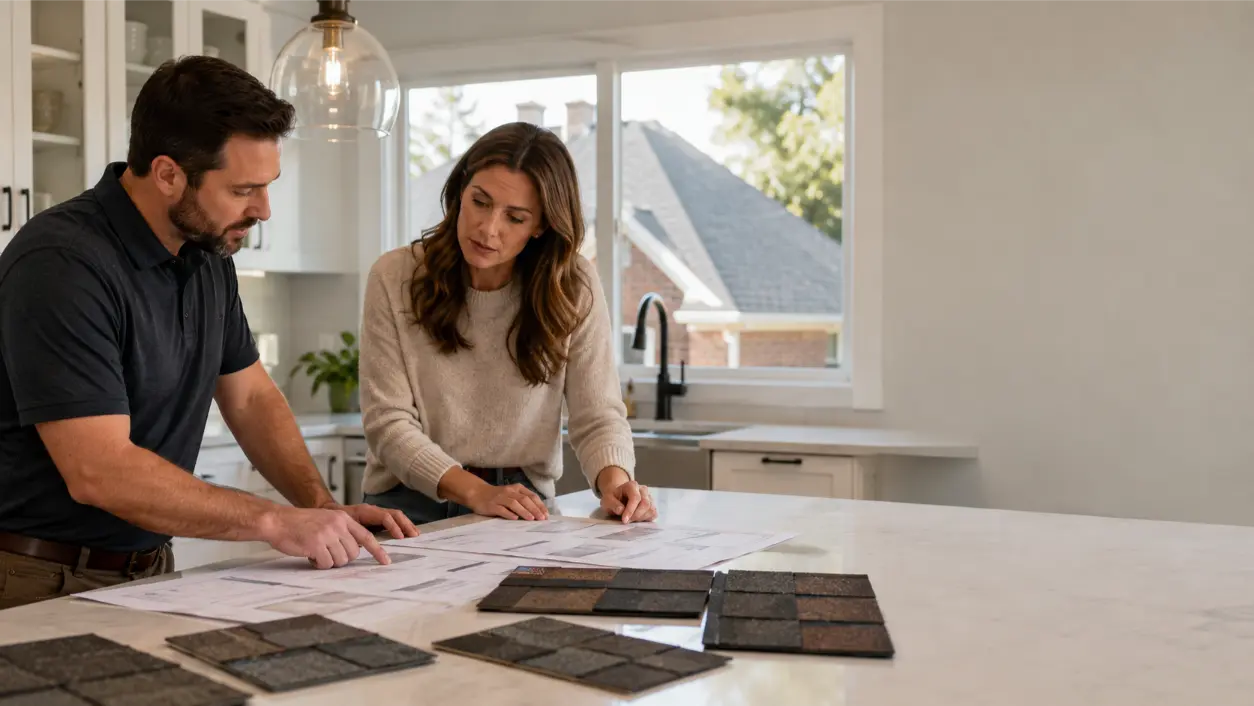
If you are comparing two or three roofing estimates, the best questions to ask roofer before signing are the ones that expose exactly what you are buying, what happens if hidden conditions are discovered, who is responsible for protecting the property, and what warranties or insurance actually apply. A roofing contract should do more than list a total price. It should make the scope, materials, timing, payment terms, cleanup, change-order process, and warranty responsibilities clear enough that both homeowner and contractor are working from the same plan.
Red Top Roofing & Exteriors serves Atlanta, Cartersville, Roswell, Rome, Alpharetta, Dallas, Kennesaw, Acworth, Marietta, Canton, Woodstock, and surrounding Georgia communities. Its current process emphasizes documented inspections, shingles, flashing, decking, ventilation, project-manager oversight, property protection, and manufacturer-backed roofing systems. Those are useful categories for any homeowner to examine before signing a roof-replacement agreement.
Why the Contract Matters More Than the Sales Conversation
A good sales conversation can explain the project, but the signed contract is what records the agreed work. Georgia’s Consumer Protection Division advises homeowners to insist on a written contract with guarantees, warranties, and promises in writing, and to include start and completion dates. It also recommends comparing written estimates based on identical project specifications rather than looking only at the bottom-line price.
That means a lower estimate is not necessarily a lower price for the same roof. One proposal may include upgraded underlayment, new flashing, ventilation corrections, debris protection, manufacturer accessories, and damaged-decking allowances, while another may leave several of those decisions open until installation.
1. What Exact Roofing System and Materials Are Included?
Do not accept a proposal that says only “architectural shingles” or “premium roof.” Ask for the manufacturer, product line, color selection process, starter shingles, ridge-cap shingles, underlayment, leak barrier, flashing materials, ventilation components, and other accessories that make up the system.
Useful questions include:
- What exact shingle manufacturer and product are you installing?
- Are starter and ridge products from the same system?
- What underlayment is included?
- Where will leak barrier or ice-and-water protection be installed?
- Which pipe boots, vents, flashing, and edge-metal components are being replaced?
- Are any existing components planned for reuse?
The goal is to compare complete systems, not just shingle names.
2. What Happens if Bad Decking Is Found After Tear-Off?
Roof decking can be partly hidden until the old roofing is removed. A strong contract should explain how damaged or unsuitable decking will be handled if it is discovered during tear-off.
Ask:
- What condition requires decking replacement?
- How is replacement decking priced?
- Will I be notified before significant additional work is performed?
- Will damaged areas be photographed before they are covered?
- What sheathing type and thickness will be used?
- How will older board or plank decking be handled if it does not meet the selected roofing system’s requirements?
A decking clause should reduce surprises rather than create an open-ended blank check.
3. How Are Ventilation and Attic Conditions Being Addressed?
A reroof should not be treated as shingles only. Ask how the contractor evaluated attic ventilation, intake, exhaust, blocked soffits, existing vents, and visible moisture or decking concerns.
Red Top Roofing’s current inspection messaging specifically includes decking and ventilation, which is important because those hidden conditions can affect the overall roof assembly. The contractor should be able to explain whether existing vents remain appropriate, whether any are being added or removed, and how the proposed setup fits the actual attic and roof design.
4. What Written Workmanship Warranty Do You Provide?
Homeowners often hear the word “warranty” without being told whether it refers to the roofing manufacturer’s product warranty, an enhanced manufacturer system warranty, or the contractor’s own workmanship warranty.
Ask for each warranty separately:
- What does the manufacturer’s material warranty cover?
- Is an enhanced or system warranty included?
- What does the contractor’s workmanship warranty cover?
- How long does each warranty last?
- Who do I contact if I have a leak or installation concern?
- Are there registration, maintenance, transfer, or installation requirements?
GAF’s current shingle warranty, for example, distinguishes manufacturing defects from damage caused by improper installation, structural defects, inadequate ventilation, and other excluded conditions. That is why homeowners should read the actual written warranty instead of relying on a verbal statement such as “lifetime roof.”
5. Can You Show Proof of Insurance?
The Georgia Attorney General’s Consumer Protection Division recommends asking contractors for proof of liability insurance, workers’ compensation, and property-damage coverage. For a roofing project, that question matters because crews are working at height, moving heavy materials, using ladders and equipment, and working around landscaping, driveways, siding, windows, and vehicles.
Ask for current proof of coverage and confirm the business name on the certificate matches the company you are hiring. If subcontracted labor will be used, ask how insurance responsibilities are handled within that arrangement.
6. What License or Business Credentials Apply to This Job?
Georgia’s Consumer Protection Division notes an important distinction: roofers are not automatically required to hold a state contractor license simply because they perform roofing work, while general contractors and certain other trades are state-licensed. However, local business-license requirements and the scope of work can still matter.
Rather than asking only, “Are you licensed?” ask:
- What Georgia contractor license, if any, applies to your company and this project scope?
- Can I verify that license through the state if applicable?
- Do you hold the required local business license?
- Who will obtain any permits required by the local jurisdiction?
This avoids treating “licensed” as a marketing slogan and turns it into something verifiable.
7. Who Is Responsible for Permits and Code Requirements?
The contract should state who is responsible for permits where required, code-related corrections within the agreed scope, and inspection coordination. Requirements can vary by jurisdiction and project type, so do not assume that every roof replacement follows exactly the same permit process.
Ask whether permit fees are included, who pulls the permit, and what happens if the local authority requires a correction or additional scope not visible before tear-off.
8. How Will My Property Be Protected During Tear-Off?
Roof replacement is a demolition project before it becomes an installation project. Shingles, nails, underlayment, flashing, and debris are removed from above landscaping, siding, windows, decks, HVAC equipment, driveways, and walkways.
Ask the contractor to explain:
- How landscaping and exterior surfaces will be protected.
- Where materials and debris containers will be placed.
- How driveways will be protected.
- How nails and small debris will be collected.
- Who is responsible if siding, gutters, windows, screens, landscaping, or pavement are damaged.
- What the final cleanup and magnetic nail sweep include.
Red Top Roofing currently highlights wheeled dump trailers as part of its property-protection approach. Whatever contractor you choose, the protection plan should be specific rather than assumed.
9. Who Will Supervise the Project?
Ask who is actually accountable on installation day. Is there an onsite project manager, a crew leader, or only a salesperson who hands the job to a separate production team?
Clarify:
- Who is my contact before installation?
- Who is onsite while work is happening?
- Who can approve a change order?
- Who performs the final walkthrough?
- Who handles warranty service after completion?
Red Top Roofing’s current site specifically promotes onsite project-manager oversight. That is the type of operational detail worth comparing across proposals.
10. What Is the Change-Order Process?
Hidden conditions are one of the biggest reasons roofing projects change after work begins. A contract should explain what happens when the crew finds deteriorated decking, concealed flashing problems, structural concerns, or other conditions outside the original scope.
Ask whether changes require written approval, how additional work is priced, what documentation you will receive, and who is authorized to approve it. Avoid a contract that allows undefined additional charges without a clear process.
11. What Are the Payment Terms?
Georgia consumer guidance warns against paying the entire job upfront and recommends considering payment terms tied to completed stages of work. A roofing contract should clearly state the deposit, progress payments if any, final payment, accepted payment methods, and what conditions trigger each payment.
Ask:
- How much is due at signing?
- When is the next payment due?
- Is final payment due only after completion?
- How are approved change orders billed?
- Are financing terms separate from the construction contract?
- Are there cancellation fees or restocking charges?
Never rely on verbal payment promises that do not match the written agreement.
12. What Start Date and Completion Window Are in Writing?
Weather makes roofing schedules somewhat variable, but the contract should still establish the expected timing and explain what can cause delays. Georgia’s Consumer Protection Division specifically recommends putting start and completion dates in writing.
Ask how weather delays, material delays, hidden decking work, permit timing, and other conditions affect the schedule.
Red Top Roofing promotes one-day roof replacement as common where weather and scope permit. The important contract question is not whether a one-day completion sounds impressive; it is whether the contractor has defined the conditions under which that timing is realistic.
13. Does the Contract Clearly State What Is Not Included?
Exclusions can be just as important as inclusions. Ask the contractor to identify what the estimate does not cover.
Possible exclusions might involve:
- Extensive decking replacement.
- Structural framing repair.
- Interior water damage.
- Gutter replacement.
- Chimney masonry.
- Skylight replacement.
- HVAC or electrical work.
- Painting or siding repairs.
The exact list varies by project. The purpose is to make boundaries visible before work begins.
14. How Will Insurance-Related Work Be Handled?
If the roof is part of an insurance claim, separate roofing scope from insurance coverage. A roofer can document conditions, prepare estimates, explain construction scope, and attend inspections where appropriate. The insurer determines coverage under the policy.
Ask:
- Will the roofing contract depend on claim approval?
- How are supplements or additional documented items handled?
- Who communicates with the carrier, and about what?
- Does the contract assign insurance proceeds or benefits?
- What amount remains the homeowner’s responsibility?
Georgia’s Consumer Protection Division also publishes specific storm-repair protections and warns homeowners to read disaster-related contractor agreements carefully. Do not sign away insurance rights or proceeds without understanding the legal effect of the document.
15. What Documentation Will I Receive at the End?
A finished roof should come with records, not just a clean driveway.
Ask whether the closeout package includes:
- Final invoice.
- Material and color information.
- Manufacturer warranty documents or registration details.
- Written workmanship warranty.
- Photos of decking or hidden conditions discovered during tear-off.
- Permit or inspection records when applicable.
- Final change-order documentation.
- Contact information for future service.
Keep those documents with your home-improvement records.
Roofing Contract Red Flags to Slow Down For
- Pressure to sign immediately.
- No written scope.
- Large undefined allowances or blank spaces.
- Materials described only in generic terms.
- No written warranty details.
- Refusal to provide proof of insurance.
- Full payment demanded before work begins.
- No clear process for decking or hidden conditions.
- No start or completion expectations.
- Verbal promises that the company will not add to the contract.
- A proposal that cannot explain cleanup, damage responsibility, or supervision.
Questions to Ask Roofer Before Signing: Quick Checklist
- What exact roofing system and products are included?
- What flashing, ventilation, underlayment, and accessories will be replaced?
- How will damaged decking be identified, documented, approved, and priced?
- What manufacturer warranty applies?
- What workmanship warranty do you provide in writing?
- Can you provide current proof of liability and workers’ compensation insurance?
- What state or local licenses apply to this scope?
- Who obtains required permits?
- How will landscaping, siding, windows, HVAC equipment, and the driveway be protected?
- Who supervises the job onsite?
- How are change orders approved?
- What are the deposit and payment terms?
- What start and completion window is written into the contract?
- What is specifically excluded?
- What closeout and warranty documentation will I receive?
Frequently Asked Questions
What Should Be in a Roofing Contract?
A roofing contract should clearly identify the parties, property, scope, roofing materials, price and payment terms, expected timing, hidden-condition or change-order process, warranties, cleanup responsibilities, and important exclusions. Permit, insurance-claim, or financing language should be clear when relevant.
Should I Ask a Roofer for Proof of Insurance?
Yes. Georgia’s Consumer Protection Division recommends asking contractors for proof of liability, workers’ compensation, and property-damage insurance. Review current documentation rather than relying only on the phrase “fully insured.”
Do Roofers Have to Be Licensed in Georgia?
Georgia’s Consumer Protection Division states that roofers are not automatically required to hold a state contractor license simply because they perform roofing work. General-contractor licensing rules, local business licenses, permits, and the contractor’s broader project scope can still apply. Ask which credentials apply to your specific job and verify them where possible.
How Should I Compare Roofing Estimates?
Compare identical scopes. Look at materials, underlayment, flashing, ventilation, decking assumptions, warranties, property protection, cleanup, supervision, exclusions, and change-order terms before comparing the total price.
What Is the Biggest Roofing Contract Red Flag?
There is no single red flag, but pressure to sign immediately without a detailed written scope should slow the process down. A legitimate contractor should be able to explain what is included, provide requested documentation, and put important promises in writing.
Choose the Contract, Not Just the Price
When three estimates sit on the kitchen table, the safest comparison is not simply which number is lowest. Compare what each contractor is promising to install, how hidden conditions will be handled, what insurance and warranties support the work, who supervises the project, how your property will be protected, and what happens if the scope changes.
Red Top Roofing & Exteriors uses a documentation-led inspection process and structured reroofing approach for Atlanta-area homeowners. Homeowners comparing proposals can request a free roof inspection from Red Top Roofing to document shingles, flashing, decking, ventilation, and storm-related conditions before committing to a replacement scope.
Roofing, contract, insurance, and legal disclaimer: This article provides general educational information and is not legal, insurance, licensing, code, engineering, or contract advice. Roofing licensing, permit requirements, insurance obligations, cancellation rights, contract rules, and warranty terms vary by project and jurisdiction and can change. Review the actual contract and written warranty documents, verify applicable credentials, and consult the appropriate government agency, attorney, insurance professional, or qualified construction professional when needed.
RELATED LINK: Georgia Attorney General Consumer Protection Division — Home Repairs and Improvements