
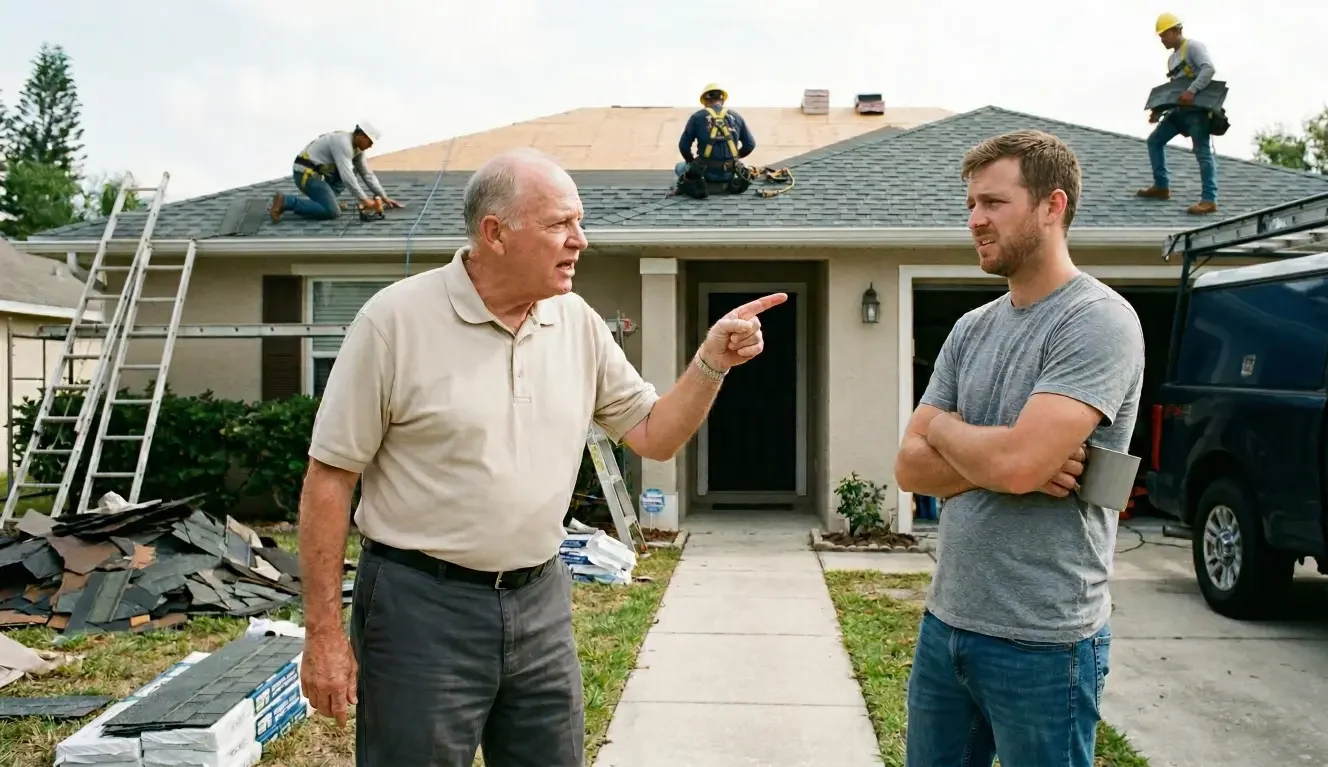
When an HOA sends out a reroofing RFP, the lowest bid or best-looking proposal is rarely the full story. The real risk is hiring a contractor who can install a roof, but cannot manage communication, resident access, safety, cleanup, and documentation across a lived-in community.
That distinction matters more than many boards expect. A contractor may be perfectly capable of replacing shingles and still create weeks of frustration if the project is poorly staged, residents are underinformed, vehicles are blocked in, debris control is inconsistent, or complaints have nowhere to go.
For HOA board members, the challenge is not just choosing someone who can roof. It is choosing a roofing contractor for HOA who can work well in a shared community where people are living, parking, walking dogs, getting children to school, and noticing every disruption in real time. If your board is in the middle of issuing a reroof RFP, the best decision usually comes from screening for project management quality before price becomes the main tie-breaker.
A practical starting point can be a [free roof inspection] that helps clarify scope before the board compares contractors too narrowly on line-item pricing alone.
Why HOA roofing projects fail even when the roof itself gets installed
Many HOA roofing projects go sideways for reasons that have little to do with whether the final roof system was installed correctly. The visible failure, from the board’s perspective, is often operational.
Residents do not experience a reroof project as a scope sheet. They experience it as noise at 7:30 a.m., a driveway they cannot use, nails in the parking area, tarps or debris near landscaping, and uncertainty about whether they were supposed to move a vehicle before crews arrived. If the contractor handles those moments poorly, the board ends up carrying the frustration.
That is why community reroofing projects need to be evaluated differently than a single-home replacement. The board is not simply buying materials and labor. It is selecting a team that will operate inside a shared environment with many moving parts and many people affected by them.
This is where some bids become misleading. A proposal may look professional because it lists shingle brand, underlayment, flashing, and square count. But if it says very little about work sequencing, resident notices, daily cleanup standards, or the chain of communication during the job, it is incomplete in the ways that matter most to an occupied community.
For an HOA, a smooth project usually depends on two separate capabilities:
- the ability to perform roofing work competently
- the ability to manage disruption responsibly across the neighborhood
Boards that evaluate only the first capability often discover the second problem too late.
The shortlist checklist: what an HOA should evaluate before comparing bids
Before the board compares numbers, it helps to create a shortlist framework. That framework should answer a simple question: which contractors appear capable of handling both the roof work and the community logistics?
A useful screening checklist should cover:
- licensing and insurance
- resident communication approach
- site access and parking coordination
- property protection and cleanup procedures
- point-of-contact structure
- documentation quality
- project oversight during installation
- how expectations would carry into the contract
This gives the board a way to separate contractors who are merely offering a roof from contractors who appear prepared to manage a community-wide reroof.
Licensing and insurance are the floor, not the full decision
Licensing and insurance checks are necessary, but they are not enough. Too many boards treat them as the full vetting process because they are easy to request and easy to compare. In reality, they only confirm that the contractor clears a basic entry threshold.
That threshold still matters. The board should ask for current licensing information where applicable, proof of insurance, and clarity on what policies are in place for the work being proposed. It is also reasonable to ask how crews and subcontractors are covered, especially if multiple buildings, shared parking areas, or common property are involved.
But none of that tells you how the project will actually feel to residents.
A contractor can provide certificates and still have weak communication habits, unclear staging plans, poor cleanup discipline, or no practical process for managing homeowner questions. That is why licensing and insurance should be treated as the beginning of evaluation, not the end of it.
Community operations matter as much as roofing scope
This is the shift many boards need to make early. In an HOA project, operations are not secondary. They are part of the job.
The board should evaluate whether the contractor seems to understand what it means to work inside an occupied community. That includes things like when notices go out, how residents are told to prepare, how shared lanes stay usable, how driveway or parking impacts are handled, what happens if weather changes the schedule, and who owns communication when there is confusion.
If a contractor talks comfortably about materials but gives vague answers about neighborhood logistics, that is a signal. It does not necessarily mean the contractor cannot do the work. It does mean the board may need to keep digging before moving forward.
Ask how the contractor plans to communicate with residents before work begins
One of the fastest ways for an HOA reroof project to create friction is weak communication before the first crew arrives. Residents do not need a technical roofing briefing. They need practical, timely instructions that help them avoid surprises.
A strong contractor should be able to explain, in plain language, how communication would work before and during the project. The board should listen for specifics rather than generic reassurances.
Helpful questions include:
- When will residents receive notice before work begins?
- What information will those notices include?
- Will notices be issued building by building, phase by phase, or all at once?
- How will residents be told where not to park, what to move, or what to protect?
- How are schedule changes communicated if weather interrupts work?
- Who handles resident questions once the project starts?
The quality of those answers matters because the board will often be blamed for communication failures even if the contractor caused them.
For example, imagine a community where crews are moving from one cluster of units to another each day. If residents are not told clearly which areas are active, some will leave vehicles in the wrong place. Others may set out patio items or decorations that should have been moved. Then the board has to step in and calm everyone down while work is already underway.
That is why a clear HOA reroof project communication plan is not a nice extra. It is part of responsible execution.
Boards should also ask whether the contractor can show examples of the kinds of notices or pre-project instructions they use. They do not need polished marketing materials. They need evidence that the contractor has thought through how residents will actually be informed.
Ask for the site access, parking, and daily work plan
Roofing in an occupied HOA is a logistics exercise as much as a construction one. A contractor may have a strong roof installation crew and still create confusion if access planning is loose.
The board should ask for a practical description of how the job would function day to day. Not in abstract terms, but in real operational terms.
Key questions include:
- Where will crew vehicles park?
- Where will materials be staged?
- How will trailers, dumpsters, or debris equipment be placed?
- What traffic or parking areas might be affected?
- How will residents be told when access changes?
- What does the daily start and stop routine look like?
- How will the contractor manage work if buildings are close together or roads are narrow?
These questions matter because community layouts are rarely neutral. Some neighborhoods have tight parking, shared alleys, limited turnaround space, landscaped islands, school drop-off overlap, or residents who work from home and need reasonable predictability.
A contractor does not have to promise zero disruption. That would not be credible. What they should be able to do is explain how disruption will be anticipated, limited where possible, and communicated clearly.
This is also where boards should look for signs of operational maturity. A contractor who can describe sequencing, crew flow, equipment placement, and building-by-building progression is usually easier to trust than one who speaks only in general terms about “getting started quickly.”
If the project may move fast under the right conditions, the board should still ask what affects that pace. Weather, scope changes, building complexity, and access constraints can all influence the schedule. A realistic answer is more useful than a confident one.
Ask what property protection and cleanup look like in practice
Cleanup is one of the most underestimated parts of contractor selection. Boards often assume it is covered because every roofer says they clean up. But “we clean up daily” is not the same as explaining what cleanup means in a neighborhood where residents walk, drive, garden, and use common spaces every day.
The board should ask what property protection looks like before work starts and what cleanup looks like before crews leave each day.
That conversation should include:
- driveways and paved surfaces
- landscaping and planted areas
- patios, decks, and resident belongings near work zones
- common walkways and entrances
- debris collection and removal
- nail and small-metal cleanup
- how the site is checked at the end of the day
This is where practical details matter. How will debris handling be managed around occupied properties? What measures help reduce risk to vehicles or driveways? How does the contractor leave a work area at the end of the day if the next building is scheduled for tomorrow?
Boards should not assume every contractor approaches these issues with the same level of discipline. Some do a better job than others of planning around shared property and minimizing mess in visible areas. Asking for the contractor’s actual process is more useful than asking whether they “take cleanup seriously.”
The same applies to resident safety. Residents may walk through active zones, children may move unpredictably, and pets may be nearby. The board should understand how the contractor thinks about active work areas, caution zones, and end-of-day conditions in spaces people continue using.
Good cleanup is not just cosmetic. In an HOA, it is part of how the contractor demonstrates respect for the community.
Do not confuse a detailed roofing proposal with a complete project-management plan
This is one of the most common misunderstandings in contractor selection.
A detailed roofing proposal can still be an incomplete project plan.
Many bids look thorough because they spell out roofing components, warranty pathways, material types, tear-off scope, and installation steps. All of that matters. But none of it automatically tells the board how the contractor will perform inside a lived-in neighborhood.
A complete project-management plan answers questions like:
- Who is the day-to-day point of contact?
- How are resident notices handled?
- How are complaints routed and resolved?
- How are parking and access issues managed?
- What is the cleanup standard at the end of each day?
- How are weather delays or sequencing changes communicated?
- How is progress tracked from one section of the community to the next?
If those answers are missing, the board should not assume they exist behind the scenes. They may. But they should be discussed explicitly before the award decision.
This is the contrarian reality that saves boards a great deal of frustration: the most polished proposal is not always the safest choice. Sometimes the better contractor is the one who gives a more grounded, operationally complete answer, even if the presentation is less glossy.
For HOA board members, the goal is not to reward the best-looking bid package. It is to reduce the chances of resident complaints, confusion, and preventable project friction once work begins.
The most common HOA contractor-selection mistakes
Most board mistakes happen before the first shingle is removed. They occur during screening, when the wrong things are treated as decisive and the right things are treated as secondary.
One common mistake is choosing based too heavily on price. Cost matters, and the board has a duty to manage budgets responsibly. But when bids are close enough to be competitive, the cheaper option can become more expensive in practical terms if it creates avoidable disruption, poor communication, or a messy closeout.
Another mistake is assuming that a contractor who performs well on single-home projects will automatically perform well in a community-wide setting. The skills overlap, but they are not identical. Managing repeated work across multiple buildings in an occupied neighborhood requires a different level of coordination.
Boards also make mistakes when they review insurance documents without asking what they mean operationally. Proof of coverage matters, but it does not answer how work around vehicles, shared spaces, or resident access will be handled.
Another frequent problem is failing to test the contractor’s communication process in advance. If the contractor cannot explain clearly how updates, notices, and resident questions will be handled before the job starts, it is risky to assume those details will become clearer later.
Some boards also rely too heavily on references without asking whether those references involved similar community conditions. A strong review from a homeowner is not the same as evidence of smooth execution across an HOA or multi-building project.
And finally, some boards leave too much unsaid in the RFP or final agreement. If expectations around notices, cleanup, work hours, staging, and communication are only discussed verbally, misunderstandings become much more likely once the project is underway.
What proof an HOA board should ask for before awarding the job
Before awarding the work, the board should ask for proof that helps verify how the contractor operates, not just what the contractor promises.
That proof may include current certificates and insurance documentation, but it should go further than compliance paperwork. The board should also look for evidence of process.
Useful proof requests can include:
- a sample scope format or documentation package
- the name or role of the primary project contact
- an explanation of how communication is handled during active work
- examples of pre-project notices or resident instructions
- a description of cleanup and site-control procedures
- an explanation of how the contractor sequences work across multiple buildings
- manufacturer affiliations or credentials where relevant
- a clear explanation of what inspection findings would be documented before work begins
The board is not trying to trap the contractor. It is trying to reduce assumptions.
This is also a good place to listen for discipline in how the contractor talks about the job. Do they explain things in a way that suggests they have thought through documentation, scope clarity, and on-site coordination? Do they seem comfortable discussing the non-roofing parts of the project? Is there a clearly assigned point of contact who would make communication easier during a community-wide reroof?
If the board is considering whether to start with inspections before final contractor selection, documented inspection findings can help clarify the condition of the roofs and frame later scope discussions more productively. That does not remove the need for due diligence, but it often gives the board a more grounded starting point than broad assumptions or vague damage descriptions.
It is also worth keeping boundaries in mind. Contractors can help document conditions and explain process steps, but insurance coverage decisions, legal interpretations, and formal compliance advice belong to the appropriate professionals.
How to turn contractor answers into a cleaner RFP and contract
The board’s questions are only useful if the answers become part of the project expectations. Otherwise, the contractor-selection process may feel thorough while the final documents remain too general.
A cleaner HOA roofing RFP should not focus only on materials, pricing, and timeline. It should also ask contractors to describe how they will manage community conditions.
That might include requested information such as:
- communication process before and during the project
- resident preparation instructions
- site access and parking plan
- staging and debris handling approach
- daily cleanup expectations
- designated point of contact
- work sequencing by building or area
- response process for resident issues during the project
When the board moves toward contract review, those expectations should be documented clearly enough that they do not depend on memory or goodwill. This does not mean overcomplicating the agreement. It means making sure the practical commitments that influenced selection are not left behind.
For example, if a contractor won the job partly because of a strong communication plan, that plan should not disappear once the contract is signed. If cleanup standards were part of the board’s confidence, they should be reflected in the working expectations. If a specific project contact was important during selection, the board should know how that communication structure will function during the actual job.
This is one of the best ways to avoid the classic post-award disappointment: “We thought they were going to handle that.”
A well-structured RFP also improves the bid process itself. When contractors know the board is evaluating operations, not just price, the responses become easier to compare on the issues that affect resident experience.
A lower-friction next step for boards that want fewer surprises
If your board is preparing an HOA reroof RFP, start with documented inspection findings and a practical conversation about project logistics.
Ask for more than a quote. Ask how the work will be managed across an occupied community.
Red Top Roofing can help you review scope, communication needs, and execution details before the project creates avoidable headaches.
That kind of conversation is especially useful when the board wants to compare contractors more intelligently. Instead of treating every bid as if it reflects the same level of planning, the board can begin with better questions, clearer expectations, and a more complete picture of what smooth execution should look like.
A reroof project will always involve some disruption. The goal is not to pretend otherwise. The goal is to choose a contractor who appears prepared to manage that disruption responsibly, communicate clearly, protect shared property, and help the project move forward without turning the board into a complaint desk.
FAQ Content
What questions should an HOA ask roofers bidding on a community-wide project?
An HOA should ask more than pricing and materials questions. The board should ask how the contractor will communicate with residents, manage parking and access, protect shared property, handle daily cleanup, sequence work across buildings, and respond to questions or complaints during the project. Those answers often reveal whether the contractor can manage a lived-in community, not just install a roof.
What should an HOA include in a roofing RFP?
A roofing RFP should include more than scope, materials, and requested pricing. It should also ask contractors to explain their resident communication process, site access plan, cleanup expectations, staging approach, point-of-contact structure, and how work will be sequenced across the community. This makes it easier to compare bids on operational quality, not just cost.
How can an HOA reduce resident complaints during a reroof project?
The most reliable way to reduce complaints is to choose a contractor with a clear communication and project-management approach. Residents usually become frustrated when they do not know what is happening, what they need to move, where they can park, or how long disruptions will last. Clear notices, predictable updates, visible cleanup standards, and a defined contact process can make a major difference.
What kind of insurance should a roofing contractor carry for HOA work?
Boards should request current insurance documentation and review whether the contractor appears properly covered for the proposed work. The exact requirements may depend on the project and the association’s standards, so the board may want legal or risk-management input where needed. The key point is that proof of insurance should be reviewed as part of broader due diligence, not treated as the only sign of readiness.
What should an HOA require in a roofing contract besides price and materials?
Beyond price and materials, the contract should reflect the practical expectations that shaped the board’s decision. That can include communication responsibilities, cleanup standards, site access expectations, the designated point of contact, work sequencing, and how resident-facing issues will be handled during the job. If those items matter during selection, they should not be left out of the final agreement.
How should an HOA compare roofing bids that look similar on paper?
When bids look similar on scope and price, the board should compare how each contractor plans to operate inside the community. Look closely at communication, project oversight, cleanup discipline, access planning, documentation quality, and how clearly the contractor answers operational questions. In many HOA projects, those differences matter as much as the roofing system itself.
If your board is preparing an HOA reroof RFP, start with documented inspection findings and a practical conversation about project logistics.
Ask for more than a quote. Ask how the work will be managed across an occupied community.
Red Top Roofing can help you review scope, communication needs, and execution details before the project creates avoidable headaches.
Free Roof Inspection in Atlanta | Red Top Roofing Cartersville GA
RELATED LINKS: