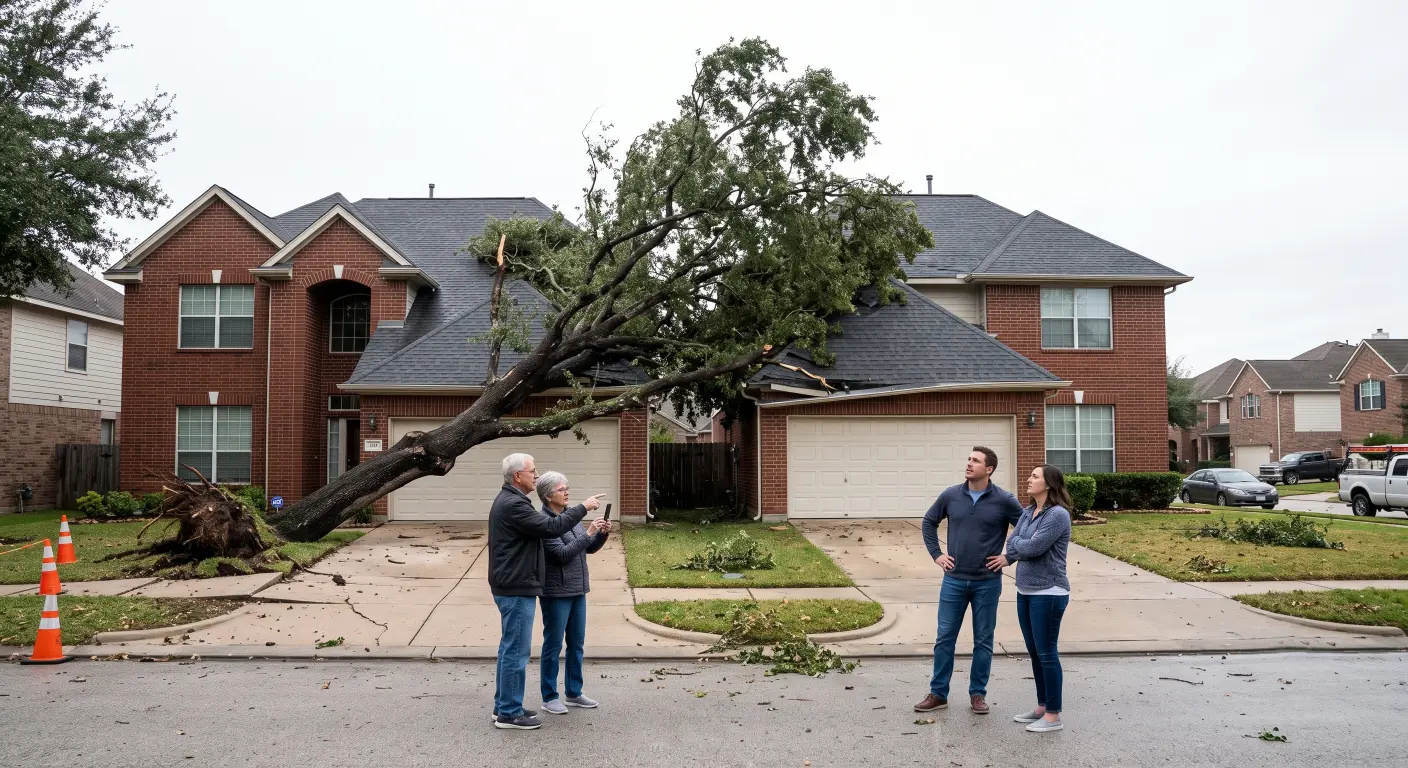
A tree comes down across a shared roof, several owners are affected, and the phones start ringing immediately. Who Pays When a Tree Damages to HOA Roof?
One owner assumes the HOA pays for everything. Another says their HO-6 should not be involved. A board member wants a fast answer for the entire community. Meanwhile, the actual roof damage still needs to be documented, emergency protection may need to happen right away, and no one wants to say the wrong thing too early.
That is why this topic gets so tense so fast.
If you manage an HOA or COA, the real problem is rarely just the fallen tree itself. It is the overlap between building responsibility, insurance structure, and owner communication. When a manager starts with the wrong frame, the message to owners often becomes too broad, too confident, or too vague to be useful. When the right frame is used, the association can usually move faster on documentation and mitigation while staying more careful about final responsibility.
This article is meant to help with that. It is general operational guidance, not legal or insurance advice. The goal is to help you think more clearly when a shared roof is damaged and multiple units are involved.
Why This Gets Confusing So Fast After a Tree Hits a Shared Roof
The first few hours after a tree strike are usually chaotic.
Someone is dealing with emergency access. Someone is asking whether the building is safe. Owners are taking pictures, sharing theories in group texts, and asking if the association is filing a claim. If interior damage is showing up in upper-floor units, the pressure rises even faster.
The confusion usually starts because people ask one question—“Who pays?”—when there are actually several different questions hiding underneath it.
There is the property question: what part of the roof or structure is shared property, and what part belongs to an owner or serves a specific unit?
There is the insurance question: which policy may respond first, if any, and for which part of the loss?
Then there is the communication question: what should the association say right now, before documents, policies, and damage scope are fully reviewed?
Those are not the same thing.
“Who owns it” and “which policy responds” are not always identical questions. A roof may be association-maintained but still involve owner-level insurance conversations for related interior damage, personal property, or other unit-specific losses. In some communities, even the definition of the roof or attached components may depend on how the governing documents define common elements, limited common elements, or unit boundaries.
That is why managers get trapped when they try to give a one-line answer too early. The event feels urgent, but the framework needs to be slower and more precise than the moment suggests.
Start With the Right Decision Frame: Damage Responsibility, Insurance Response, and Owner Communication Are Three Different Tracks
When a large tree falls on a building serving multiple units, it helps to separate the situation into three tracks right away.
The first track is damage responsibility. This is the question of who is generally responsible for the repair or maintenance of the affected part of the building under the association’s governing structure. That often starts with the declaration, bylaws, plats, maintenance matrix, or other community-specific documents.
The second track is insurance response. This is not exactly the same as maintenance responsibility. It is the question of which carrier or policy may be involved, whether there is likely a master policy conversation, whether owners may need to contact their HO-6 carriers, and whether more than one claim path may be unfolding at the same time.
The third track is owner communication. This is what the association should say while the first two tracks are still being sorted out. It includes how to explain the process, how to avoid overpromising, and how to keep owners informed without stepping into legal or insurance conclusions the association is not ready to make.
This framing matters because it keeps the association from blending everything into one messy conversation.
If you treat all three tracks as one issue, you may accidentally do things like:
- Promise a coverage result before the carrier has reviewed anything
- Imply the HOA is denying responsibility when the documents have not been analyzed
- Delay emergency mitigation because no one wants to authorize work before the payment question is settled
A better approach is more disciplined. Stabilize the situation. Document the damage. Review the governing documents and insurance structure. Communicate process clearly. Then move from likely path to firmer position as facts improve.
That sequence may feel slower, but it is usually safer and more useful.
The First Questions an HOA or COA Manager Should Answer
Before you try to explain the event to the whole building, answer a few foundational questions.
What part of the roof or building is actually shared property?
Start with the physical scope.
Was the tree on a main roof serving multiple units? Did it damage a shared roof section, an overhang, a structural element, or an area tied more directly to one owner’s unit? Did it affect exterior building systems only, or did it create interior damage inside specific units as well?
This sounds basic, but it matters. The more precise the physical description, the easier it becomes to sort the next steps. Shared roof sections, unit-specific interior finishes, and owner belongings may all be affected by the same tree event while still falling into different responsibility conversations.
What do the governing documents say about maintenance and insurable responsibility?
This is where many associations realize they need to slow down.
Responsibility often depends on how the association documents and insurance structure define the property and repair obligations. A manager may assume the roof is automatically an HOA issue because it is shared, but the governing documents may contain important distinctions about common elements, limited common elements, insurable obligations, or unit-level restoration.
The key here is not to improvise from memory. Pull the actual language. If the event is large enough, this is often the point where association counsel, the manager, the board, and the insurance professional all need to stay aligned.
Is this likely a master policy issue, an HO-6 issue, or both?
This is where the article’s main question—who pays for tree damage to HOA roof—usually starts to split into several smaller answers.
In some associations, the master policy is the obvious first place to look for damage to the shared building envelope. In others, one event may trigger more than one insurance conversation. A building-level claim path may exist at the same time as owner-level HO-6 questions about interiors, deductibles, betterments, or personal property.
That does not mean both policies always apply. It does mean managers should resist giving an early “only this policy matters” answer unless the documents and structure make that unusually clear.
Are there interior damages that may involve individual owners separately?
A tree on a shared roof does not only create roof damage.
It may also create ceiling damage, water intrusion, drywall damage, insulation issues, flooring damage, damaged personal property, temporary relocation questions, or disputes over what belongs to the building versus the owner. Roof damage and unit-level interior damage do not always follow the same responsibility path.
That is why a manager should identify early whether the event is limited to the roof and exterior shell or whether upper-floor or adjacent units are already showing loss inside. The broader the impact, the more likely owner communication must address both association-level and owner-level next steps.
What needs to be documented before cleanup and temporary repairs move forward?
In a real emergency, the association cannot wait for perfect certainty before acting.
But it should document before the scene changes too much. That usually means photos of the tree impact, the damaged roof area, elevations, affected common elements, and visible interior impacts where accessible. It may also mean noting weather conditions, emergency safety concerns, and the sequence of events if that will later matter for claims or board records.
Immediate stabilization may need to happen while insurance and document review are still ongoing. That is normal. The goal is not to freeze action until all responsibility questions are settled. The goal is to document well enough that necessary mitigation does not erase the story of the loss.
Master Policy vs HO-6: Where the Confusion Usually Starts
This is the part owners often care about first and understand least.
In broad terms, the master policy is typically associated with the building or shared property structure, while the HO-6 is usually associated with an individual owner’s unit-level interests. But that simple summary becomes unreliable fast if people treat it like a universal rule.
Every association is structured differently. Condominiums, townhome communities, and other common-interest arrangements do not always define property and insurance the same way. Even within the same market, communities can handle insurable boundaries differently depending on their governing documents and policy setup.
So when people ask about master policy vs individual condo policy roof claim scenarios, the safest answer is usually a process answer, not a final conclusion.
A tree strike on a shared roof may look like a master policy issue at the building level. At the same time, a unit owner may still need to speak with their HO-6 carrier if interior damage, personal property loss, temporary living costs, or deductible-related questions arise. In some associations, one event may involve both a master policy and one or more owner HO-6 claims.
That is why managers should be careful with phrases like:
- “The HOA policy will handle everything.”
- “This has nothing to do with your HO-6.”
- “Owners are fully responsible for the interior.”
- “The association is not involved once the water gets inside.”
Those kinds of statements often go too far too early.
A better approach is to explain that the association is documenting the building-level damage, reviewing the governing documents, and coordinating the appropriate insurance conversations. Owners can then be told whether they may also want to notify their HO-6 carrier based on unit-specific impacts, without the manager making a final coverage determination on the spot.
The Contrarian Reality: “Who Pays” Is Usually Not a One-Line Answer
The hardest part of these events is that everyone wants a simple answer.
Boards want to reassure the community. Owners want to know whether to worry. Vendors want to know how the job will be paid. But the phrase “who pays” often hides too much complexity to answer responsibly in one sentence.
That is the contrarian reality here.
A tree hits a shared roof, and the event feels singular. But the responsibility picture may not be singular at all. There may be building-level damage, unit-level damage, emergency mitigation, long-term repairs, deductible questions, and owner-specific losses all flowing from the same incident.
This is where managers get into trouble if they confuse operational responsibility with final cost allocation.
The association may need to act quickly on roof stabilization because the building needs protection. That does not automatically settle all downstream insurance or reimbursement questions. Likewise, a unit owner may ultimately have an HO-6 conversation without that meaning the association has no role in the shared roof repair path.
So if you are handling tree on shared roof townhomes, condos, or other multi-unit buildings, the best mindset is layered, not binary.
Instead of asking for one total answer too soon, ask:
- What does the association need to do right now?
- What part of the damage appears to fall within shared building responsibility?
- What owner-level impacts may need separate follow-up?
- What is the likely insurance path?
- What still needs review before the association takes a hard position?
That kind of framing is less satisfying emotionally, but much more useful operationally.
What to Tell Affected Owners in the First 24 Hours
The first owner message matters a lot.
It sets the tone for whether the association sounds organized, evasive, reckless, or calm. In the first 24 hours, the goal is not to sound definitive. The goal is to sound clear, active, and careful.
What managers can usually say safely:
- The association is aware of the damage
- Emergency safety and stabilization steps are underway or being coordinated
- The damage is being documented
- The association is reviewing governing documents and the relevant insurance process
- Additional updates will follow as more facts become available
What managers should usually avoid saying too early:
- That the HOA will pay for everything
- That owners must handle everything themselves
- That a claim definitely will or will not be covered
- That one specific policy is the only policy involved
- That final responsibility has already been determined
That does not mean the message should be vague. It means the message should separate what is known from what is still being reviewed.
A practical early message might sound like this in plain language:
The association is coordinating emergency response and documenting the roof damage caused by the fallen tree. We are reviewing the building impact, our governing documents, and the relevant insurance process. Owners with visible interior damage should also document their unit conditions and may wish to notify their HO-6 carrier while we continue evaluating the shared building damage. We will provide updates as we confirm the next steps.
That kind of message does three useful things. It shows action. It avoids false certainty. And it gives owners something productive to do without pretending the whole answer is already known.
Common Mistakes Associations Make After Tree Damage to a Shared Roof
One common mistake is waiting too long to document.
In a chaotic event, people focus on cleanup, contractor calls, and board pressure. But if the association does not document the roof strike, the building conditions, and the visible impacts early enough, later conversations become harder. Associations often need to document and stabilize the damage before final responsibility questions are fully resolved.
Another mistake is promising coverage answers before policies are reviewed.
This often comes from good intentions. A manager wants to calm people down, so they say more than they really know. But it is usually safer to explain the process than to promise a final coverage answer too early. Once an association says, “This is definitely the HOA’s responsibility,” or “Owners will need to take care of their own losses,” it becomes harder to walk that back if the documents or policy review point somewhere more nuanced.
A third mistake is treating roof repair, interior damage, and owner communication as one issue.
They are related, but not identical. The shared roof may need immediate work. Affected owners may have unit damage that needs separate documentation. The board may need a structured briefing. Trying to collapse all of that into one conversation usually produces confusion.
Another mistake is delaying mitigation while responsibility is still being sorted out.
The building may need tarping, drying, temporary stabilization, or controlled access long before final cost allocation becomes clear. Waiting for total certainty before taking basic protective action can create bigger problems for everyone involved.
What Good Verification Looks Like Before the Association Takes a Hard Position
Before the association tells owners a firm answer about responsibility, it should try to build a better verification base.
That usually includes several layers.
First is damage documentation. Clear photos, contractor observations, notes about impacted areas, and records of emergency mitigation all help. If the roof was punctured, displaced, or structurally compromised, that needs to be captured clearly.
Second is operational stabilization. If the building needs tarping, drying, access control, or temporary protection, that work may need to happen while the longer review continues.
Third is document review. The association should understand what its governing documents appear to say about the shared roof, maintenance responsibility, repair obligations, and unit boundaries.
Fourth is insurance review. The association needs enough information from the carrier, broker, or relevant professionals to distinguish a likely claim path from a final coverage determination.
That difference matters. “Likely path” means the association is starting to understand how the event may be handled. “Final determination” means the relevant documents, carrier positions, and facts have been reviewed more fully. Those are not the same thing.
Good verification does not eliminate uncertainty instantly. It reduces the chance that the association communicates too much too soon.
A documented roof inspection can also help here. Not because it answers legal questions, but because it gives the association a clearer picture of what happened, what needs attention first, and what information may support insurer conversations.
If a tree has hit a shared roof and the responsibility questions are still unfolding, start with documentation and clarity. A documented roof inspection can help your association understand the visible damage, support insurer conversations, and communicate more calmly with affected owners. No pressure—just a clearer picture of what happened and what needs attention first.
The Best Next Step When You Need Clarity, Documentation, and a Calm Owner Message
If your association is in the middle of this exact scenario, the next step is usually not trying to sound more certain than the facts allow.
It is getting clearer, faster.
That means documenting the roof damage, stabilizing the building if needed, pulling the governing documents, coordinating the insurance conversation, and giving owners a message based on process rather than assumptions. It also means resisting pressure to treat “who pays for tree damage to HOA roof” like a one-line answer when the event affects shared structures and individual units at the same time.
The best next step is operational clarity.
Once the roof damage is documented well, the association is in a better position to speak with owners, carriers, counsel, and contractors without mixing up maintenance responsibility, insurance response, and communication strategy. That usually leads to calmer updates and fewer avoidable misunderstandings.
If a tree has hit a shared roof and the responsibility questions are still unfolding, start with documentation and clarity. A documented roof inspection can help your association understand the visible damage, support insurer conversations, and communicate more calmly with affected owners. No pressure—just a clearer picture of what happened and what needs attention first.
FAQ
Who pays for tree damage to an HOA roof?
There is not one universal answer. Responsibility often depends on how the association documents and insurance structure define the property and repair obligations. A shared roof event may involve building-level responsibility questions, insurance review, and separate owner-level issues at the same time.
Does the HOA master policy cover roof damage from a fallen tree?
It may, but that depends on the association’s policy structure and the facts of the loss. In many communities, a tree strike to a shared roof creates a master policy conversation, but that should not be treated as a guaranteed or exclusive answer without reviewing the actual policy and governing setup.
When would an owner’s HO-6 policy be involved after shared roof damage?
An HO-6 may become part of the conversation when a unit owner has interior damage, personal property loss, temporary living concerns, or other unit-specific impacts. In some associations, one event may trigger more than one insurance conversation.
Who pays for interior damage if a tree hits a condo or townhome building?
That can be more complicated than the roof damage itself. Roof damage and unit-level interior damage do not always follow the same responsibility path, which is why managers should be careful not to give broad answers before documents and insurance structure are reviewed.
What should an HOA tell owners right after a tree damages the roof?
The safest early message is usually process-based. Let owners know the association is aware of the damage, coordinating emergency response, documenting the loss, and reviewing next steps. Avoid promising final coverage or responsibility answers before those reviews are complete.
Can the association approve emergency roof work before insurance decisions are final?
Often, emergency stabilization may need to happen before final responsibility questions are fully resolved. The association should still document the condition carefully and coordinate the work in a way that supports later review, but urgent protective action does not always wait for a final insurance conclusion.
If a tree has hit a shared roof and the responsibility questions are still unfolding, start with documentation and clarity. A documented roof inspection can help your association understand the visible damage, support insurer conversations, and communicate more calmly with affected owners. No pressure—just a clearer picture of what happened and what needs attention first.
RELATED LINK:
National Association of Insurance Commissioners – consumer insurance guidance